
Roof Replacement Cost for a 3,000 Sq Ft House (2026 Contractor’s Guide)
Facing a roof replacement is one of the biggest financial decisions a homeowner can make. It’s a major expense, and the sea of information online can be confusing. If you own a 3,000 square foot house, you’re likely wondering: “What’s the real bottom line?” This comprehensive 2026 guide will break down every factor that goes into the cost, from material selection to regional labor rates, installation processes, financing options, and post-installation maintenance. We’ll give you the insider knowledge you need to budget intelligently, hire the right contractor, and ensure your investment protects your home for decades to come.
The Quick Answer: Estimated Cost Range for 2026
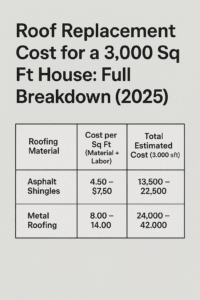
The average cost to replace a roof on a 3,000 sq. ft. U.S. home in 2026 typically falls into these ranges, depending heavily on material, location, and roof complexity:
*Note: These are national averages for a complete tear-off and replacement. Your actual cost will vary based on geographic location, roof complexity, and current market conditions.
Key Factors That Influence Your Roof Replacement Cost
A 3,000 sq. ft. house is just a starting point. To understand your specific quote, you need to know how professional roofers calculate the price. It’s not just about materials; it’s a combination of these critical factors that can easily double or triple your final bill if not properly understood.
1. Actual Roof Area & Pitch (Slope) – The Critical Multiplier
This is the most important concept to grasp: a 3,000 sq. ft. house does not have a 3,000 sq. ft. roof. The roof’s total surface area is always larger due to its pitch, or slope. A steep, dramatic A-frame roof has significantly more surface area than a low-slope ranch-style roof on a house with the same square footage.
Pitch Multiplier Table
Use this table to estimate your actual roof area:
| Roof Pitch | Description | Multiplier | Estimated Roof Area for 3,000 sq ft Home |
|---|---|---|---|
| 4/12 | Low Slope | 1.05 | 3,150 sq ft |
| 6/12 | Moderate | 1.12 | 3,360 sq ft |
| 8/12 | Steep | 1.20 | 3,600 sq ft |
| 12/12 | Very Steep | 1.41 | 4,230 sq ft |
A steeper pitch (e.g., 8/12 or higher) is more dangerous and difficult for a crew to work on, which increases labor costs due to safety equipment, specialized harness systems, and slower work pace. In some regions, steep roofs can add 25-50% to labor costs alone.
2. Roofing Material (The Biggest Cost Driver)
The material you choose will have the single largest impact on your total bill. Beyond just the base cost, different materials require different installation techniques, specialized tools, and varying levels of expertise. We’ll break this down in detail below, but the difference between basic asphalt shingles and luxury slate tiles can be over $50,000 for a 3,000 sq. ft. home.
3. Labor Costs (Geographic Variation Is Significant)
Labor accounts for roughly 40-60% of the total project cost. A roofing crew in San Jose, California, will have higher labor rates than a crew in Tulsa, Oklahoma. Union versus non-union areas can also create substantial differences. This geographic variation is a major reason why national cost averages can be misleading. In high-cost-of-living areas like New York City or San Francisco, labor rates can be 40-60% higher than the national average.
4. Old Roof Tear-Off and Disposal: Hidden Costs
A proper roof replacement includes a full tear-off of the old shingles and underlayment. The cost of this labor, plus the fees for the disposal dumpster (typically called a “roll-off”), will be line items in your quote. If you have multiple layers of old shingles (from a previous roof-over), the tear-off will cost more. Disposal fees have increased significantly in recent years due to environmental regulations, with many landfills charging by weight and restricting certain materials.
5. The “Big Unknown”: Decking and Underlayment Condition
The roof decking is the wood sheathing (usually plywood or OSB) that sits on top of your rafters and below the roofing material. A roofer cannot know the condition of your decking until the old roof is torn off. If they discover soft, rotten, or delaminated wood, it must be replaced at an additional cost, typically priced per sheet of plywood (4’x8′ sheets).
Decking Replacement Reality Check
In our experience, approximately 20-30% of homes undergoing roof replacement require some decking replacement. In older homes (40+ years), this percentage can climb to 50%. Budget an additional $500-$2,000 for decking repairs, and understand that this is a critical repair—installing new roofing over compromised decking guarantees future problems.
6. Roof Complexity: The Detail Multiplier
A simple, rectangular gable roof is the cheapest to replace. The price increases dramatically with complexity. Every time a roofer has to cut and seal around a feature, it adds time and material cost. Complex features include:
Valleys and Hips
Where two roof planes meet. Valleys (internal corners) are particularly vulnerable to leaks and require special installation techniques.
Cost Impact: Each valley adds $150-$400 to the project.
Dormers
Windows that project from the roof. Each dormer creates multiple flashing points and complex intersections.
Cost Impact: $500-$1,500 per dormer.
Skylights
Require intricate flashing systems and often necessitate integration with the roof’s water barrier system.
Cost Impact: $300-$800 each for proper flashing during re-roofing.
Detailed Material Cost Analysis for 2026
Choosing your roofing material is the most significant decision you’ll make. Each material has distinct advantages, drawbacks, and cost implications. Here’s an exhaustive breakdown of all major roofing materials available in 2026 for a 3,000 sq. ft. home.
| Material Type | Cost per sq. ft. | Total Cost Range (3,000 sq ft home) | Lifespan | Weight (lbs/sq ft) | Energy Efficiency | Maintenance Level |
|---|---|---|---|---|---|---|
| 3-Tab Asphalt | $3.50 – $5.50 | $8,400 – $13,200 | 15-20 years | 2.0-2.5 | Standard | Low |
| Architectural Asphalt | $5.50 – $13.00 | $12,600 – $26,500 | 25-30 years | 2.5-4.0 | Standard to High | Low |
| Standing Seam Metal | $11.00 – $21.00 | $25,500 – $48,000 | 50-70 years | 1.0-2.0 | Excellent | Very Low |
| Metal Shingles | $8.50 – $15.00 | $19,500 – $34,500 | 40-60 years | 1.5-2.5 | Excellent | Very Low |
| Wood Shakes (Cedar) | $10.00 – $19.00 | $21,000 – $42,500 | 30-40 years | 2.5-3.5 | Good | High |
| Clay Tile | $15.00 – $30.00+ | $36,000 – $72,000+ | 50-100+ years | 9.0-12.0 | Excellent | Moderate |
| Concrete Tile | $13.00 – $27.00+ | $31,500 – $63,000+ | 50-75 years | 8.0-10.0 | Excellent | Moderate |
| Natural Slate | $16.00 – $38.00+ | $42,000 – $90,000+ | 100+ years | 8.0-12.0 | Excellent | Low |
| Synthetic Slate | $12.00 – $18.00 | $27,000 – $40,500 | 40-60 years | 2.5-4.0 | Good | Low |
| TPO/PVC (Flat Roof) | $8.00 – $14.00 | $18,000 – $31,500 | 20-30 years | 0.5-1.0 | Excellent | Moderate |
Architectural Asphalt Shingles: The American Standard
Architectural asphalt shingles (also called dimensional or laminate shingles) represent over 70% of the residential roofing market for good reason. They offer an excellent balance of cost, durability, and aesthetics. Modern architectural shingles are far superior to older “3-tab” shingles and provide a dimensional look that can mimic wood shakes or slate at a fraction of the cost.
2026 Asphalt Shingle Technology Update
The latest asphalt shingles for 2026 feature improved technologies including:
- Advanced Granule Technology: Better UV resistance and color retention
- Integrated Algae Resistance: Built-in copper or zinc strips to prevent streaking
- High Wind Ratings: Many now carry 130+ mph wind warranties
- Cool Roof Options: Special reflective granules that meet Energy Star requirements
- Impact Resistance: Class 4 rated shingles for hail-prone regions
Metal Roofing: The Long-Term Investment
Metal roofing has seen tremendous growth in popularity over the last decade, and for 2026, it continues to be a smart long-term investment. While more expensive upfront, a standing seam metal roof can last more than twice as long as an asphalt roof. Modern metal roofs come in a variety of styles, colors, and finishes that can complement any architectural style.
Tile & Slate: Lifetime Roof Systems
Clay, concrete, and natural slate roofs are considered “lifetime” roofs. They are incredibly heavy and require the home’s structure to be engineered to support the weight. Installation is highly specialized and expensive. In earthquake-prone areas, special attachment systems are required. Slate is the pinnacle of luxury and durability, often seen on historic or high-end custom homes, but requires specialized maintenance and repair expertise.
The Complete Installation Process: What to Expect
Understanding the roof replacement process from start to finish helps you manage expectations and recognize quality work. Here’s a detailed timeline of what happens during a professional roof replacement.
Day 1: Preparation & Setup (8:00 AM – 10:00 AM)
The crew arrives and sets up safety equipment, including roof brackets, harness anchor points, and scaffolding if needed. They’ll lay protective tarps over landscaping, install plywood walkways on the lawn if necessary, and position dumpsters and material delivery areas. A thorough walkthrough with the project foreman ensures everyone understands the scope and any special considerations.
Day 1: Tear-Off Begins (10:00 AM – End of Day)
The old roofing material is removed using roofing shovels and pitchforks. Materials are loaded into wheelbarrows and dumped into the roll-off container. During this process, the crew inspects the decking for damage. Any compromised decking is marked for replacement. This is the noisiest and messiest part of the process.
Day 2: Decking Repair & Underlayment (Full Day)
All marked decking is replaced with new plywood or OSB. The entire roof deck is then covered with synthetic underlayment (a significant upgrade from traditional felt paper). Ice and water shield is installed in critical areas: valleys, eaves, around chimneys and skylights, and in all roof-to-wall intersections. Drip edge metal is installed along all eaves and rakes.
Day 3-4: Main Roofing Installation
The primary roofing material is installed according to manufacturer specifications. For shingles, this includes starter strips, proper alignment, and correct nailing patterns. For metal, panels are measured, cut, and fastened with specialized clips or screws with neoprene washers. Flashing is custom-fabricated and installed at all penetrations and intersections.
Final Day: Finishing Touches & Cleanup
Ridge vents are installed, final flashing details are completed, and all penetrations are sealed. The crew performs a thorough magnetic sweep of the property to collect nails and metal debris. Protective coverings are removed, and the site is cleaned. The project foreman conducts a final inspection with the homeowner.
What You Should Do During Installation
- Remove wall decorations that might vibrate loose
- Cover items in your attic with plastic sheeting
- Keep pets indoors or make arrangements for them
- Park vehicles away from the house
- Inform neighbors about the project timeline
- Be available for questions but give the crew space to work safely
State-by-State Cost Analysis for 2026
National averages tell only part of the story. Labor costs, material availability, building codes, and climate requirements vary dramatically by state. Here’s a comprehensive look at what you can expect to pay in different regions of the country.
California
High labor costs, strict building codes, and frequent seismic requirements drive prices up. Many areas require Class A fire-rated materials.
Texas
Competitive market with moderate labor costs. High wind and hail areas require impact-resistant materials with special warranties.
Florida
Hurricane codes require special fastening systems. High humidity affects material choices. Insurance requirements can dictate specifications.
New York
Union labor areas have higher costs. Snow load requirements affect structural considerations. Historic districts may restrict material choices.
Colorado
Hail damage is common, making impact-resistant shingles a wise investment. Large temperature swings require durable materials.
Arizona
Extreme UV exposure requires materials with excellent sun resistance. Cool roof technologies are popular for energy savings.
Illinois
Four-season climate with freeze-thaw cycles requires robust ice and water protection. Building codes vary significantly by municipality.
Georgia
Moderate climate but high humidity. Algae-resistant shingles are recommended. Competitive market keeps prices reasonable.
Regional Climate Considerations
Your local climate should heavily influence your material choice and installation specifications:
| Climate Type | Recommended Materials | Critical Installation Features | Average Cost Premium |
|---|---|---|---|
| High Wind/Hurricane | Metal, impact-resistant asphalt | Enhanced fastening, sealed decks | 15-25% |
| Heavy Snow | Metal, slate, architectural asphalt | Ice/water shield, proper ventilation | 10-20% |
| Extreme Heat/Sun | Clay tile, metal, cool roof shingles | Radiant barriers, light colors | 10-15% |
| High Rainfall | Metal, slate, synthetic slate | Enhanced drainage, sealed valleys | 5-15% |
| Freeze-Thaw Cycles | Slate, metal, quality asphalt | Ice/water shield, proper flashing | 10-20% |
Financing Your Roof Replacement: Complete Guide
Most homeowners don’t have $20,000-$50,000 sitting in cash for a roof replacement. Fortunately, numerous financing options exist. Understanding these can make your project affordable without compromising quality.
Home Equity Options
Home Equity Loan
A second mortgage with fixed rates and predictable payments. Best for homeowners with significant equity who want stability.
Pros: Fixed interest rates, predictable payments, interest may be tax-deductible
Cons: Closing costs, uses your home as collateral
Typical Terms: 5-20 years, 5-8% interest (2026 rates)
HELOC (Home Equity Line of Credit)
A revolving credit line based on home equity. Flexible draw periods make it ideal for projects with variable costs.
Pros: Pay interest only on what you use, flexible access to funds
Cons: Variable interest rates, can tempt overspending
Typical Terms: 10-year draw period, then 20-year repayment
Cash-Out Refinance
Replace your current mortgage with a larger one and take the difference in cash. Best when current rates are lower than your existing rate.
Pros: Lower rates than other options, consolidates debt
Cons: Resets mortgage clock, significant closing costs
Best When: Rates are 0.75%+ lower than current mortgage
Roofing Contractor Financing
Many reputable roofing companies partner with lending institutions to offer project-specific financing. These programs are designed specifically for home improvements and often feature:
2026 Contractor Financing Trends
- Deferred Interest Plans: 6-18 months same-as-cash if paid in full
- Low APR Options: Rates as low as 3.99% for qualified buyers
- Quick Approval: Often same-day decisions with soft credit checks
- No Prepayment Penalties: Pay off early without fees
- Loan Amounts: Typically $5,000 – $100,000
Insurance Financing for Storm Damage
If your roof replacement is due to covered storm damage, your insurance company may work with a preferred contractor who offers “insurance financing.” This arrangement allows work to begin immediately while claims are processed. Key considerations:
- Deductible Financing: Some contractors will roll your deductible into the financing
- Supplement Negotiation: Reputable contractors will negotiate with adjusters to ensure proper coverage
- ACV vs. RCV: Understand Actual Cash Value vs. Replacement Cost Value policies
- Direct Payment: Insurance companies often pay the homeowner, not the contractor
Government and Energy Efficiency Programs
For 2026, several programs can help offset roofing costs:
| Program | Eligibility | Benefit | How to Apply |
|---|---|---|---|
| Energy Star Tax Credits | Cool roof materials meeting specific reflectivity | Up to $500 federal tax credit | IRS Form 5695 with tax return |
| FHA 203(k) Loan | Home purchase or refinance with improvements | Finances roof with mortgage | Through FHA-approved lender |
| State Energy Programs | Varies by state | Rebates, low-interest loans | State energy office website |
| Local Utility Rebates | Installing approved cool roofs | $100-$500 rebate | Utility company website |
Understanding Roofing Warranties: What’s Really Covered
Warranties can be the most confusing aspect of roof replacement. There are typically three types of warranties involved, and understanding the differences is crucial.
1. Manufacturer’s Material Warranty
This warranty covers defects in the roofing material itself. They range from 20-year limited warranties to lifetime warranties. Key terms to understand:
Manufacturer Warranty Limitations
- Prorated vs. Non-prorated: Many “lifetime” warranties are heavily prorated after the first 10 years
- Transferability: Some warranties aren’t transferable to new homeowners
- Maintenance Requirements: Failure to perform required maintenance voids many warranties
- Installation Requirements: Must be installed exactly per manufacturer specs
- Exclusions: Acts of God, algae, moss, and color fading are often excluded
2. Workmanship Warranty (Labor Warranty)
This is provided by the roofing contractor and covers installation errors. These typically range from 1-10 years, with 5 years being industry standard for reputable contractors. A longer workmanship warranty often indicates a contractor confident in their quality.
3. Enhanced/System Warranties
Some manufacturers offer enhanced warranties when their complete system (including underlayment, flashing, and ventilation) is installed by certified contractors. These can provide better coverage but usually come at a premium cost.
Energy Efficiency and Cool Roof Technologies
Your roof choice significantly impacts your home’s energy efficiency. For 2026, cool roof technologies have advanced considerably, offering substantial savings in heating and cooling costs.
Cool Roof Benefits by Region
| Climate Zone | Annual Energy Savings | Best Cool Roof Options | Payback Period |
|---|---|---|---|
| Hot/Dry (AZ, NV, NM) | 15-25% on cooling | White metal, white tile, high-SRI asphalt | 3-7 years |
| Hot/Humid (FL, LA, TX Coast) | 10-20% on cooling | Light-colored metal, reflective shingles | 4-8 years |
| Mixed (CA, GA, SC) | 7-15% net savings | Medium-colored reflective materials | 5-10 years |
| Cold (MN, WI, MI) | May increase heating costs slightly | Dark colors for winter heat gain | Not recommended |
Solar-Ready Roof Considerations
If you’re considering solar panels in the future, your roof replacement presents the perfect opportunity to prepare:
Optimal Roof Orientation
South-facing roofs produce the most solar energy. If replacing only part of your roof, prioritize southern exposures.
Material Compatibility
Metal roofs are ideal for solar – panels can be mounted without roof penetration. Asphalt shingles work well but require penetrations.
Structural Reinforcement
Solar adds 3-5 lbs per square foot. Consider adding extra roof decking or structural support during replacement.
Navigating Insurance Claims for Roof Replacement
If your roof needs replacement due to storm damage, navigating the insurance claim process correctly can mean the difference between full coverage and significant out-of-pocket expenses.
Step 1: Document the Damage Immediately
Take clear photos and videos of all damage from multiple angles. Include date stamps. Document any interior water damage. Keep records of any temporary repairs made to prevent further damage.
Step 2: Have a Professional Inspection
Hire a reputable roofing contractor to perform a detailed inspection. They can identify hail hits, wind damage, and other issues an adjuster might miss. Get a written report with photos.
Step 3: File Your Claim Properly
Contact your insurance company and file the claim. Provide your documentation but avoid giving recorded statements until you’ve consulted with your contractor.
Step 4: Meet with the Insurance Adjuster
Have your contractor present during the adjuster’s inspection. They can point out damage the adjuster might overlook and ensure proper documentation.
Step 5: Review the Insurance Estimate
Insurance estimates are often based on regional averages, not your specific roof. Your contractor should prepare a line-item estimate to compare and identify gaps.
Step 6: Negotiate Supplement if Needed
If the insurance estimate is insufficient, your contractor can prepare a “supplement” request with documentation for additional necessary items.
Insurance Claim Tips for 2026
- Know Your Policy: Understand your deductible, coverage limits, and ACV vs. RCV
- Don’t Sign Anything Quickly: Some contractors ask you to sign an “assignment of benefits” – understand what this means
- Get Multiple Opinions: If the claim is denied, consider a public adjuster or independent engineer
- Timing Matters: Most policies require claims to be filed within one year of the damage event
- Code Upgrades: Insurance often pays for required code upgrades, but you may need to ask
Permits, Inspections, and Local Regulations
Most municipalities require permits for roof replacement. Understanding this process prevents delays and ensures compliance.
Typical Permit Requirements
| Requirement | Purpose | Typical Cost | Who Obtains |
|---|---|---|---|
| Building Permit | Ensures code compliance | $100-$500 | Contractor or homeowner |
| Historic District Approval | Preserves architectural integrity | $0-$200 + review time | Homeowner with contractor input |
| HOA Approval | Maintains community standards | Varies, often just application | Homeowner |
| Final Inspection | Verifies proper installation | Included in permit fee | City/county inspector |
Maintenance and Care for Your New Roof
A new roof is a major investment. Proper maintenance extends its life and protects your warranty.
Annual Maintenance Checklist
Spring
- Clean gutters and downspouts
- Inspect for winter damage
- Check flashing around chimneys
- Trim overhanging branches
Fall
- Clean gutters again
- Check for loose or damaged shingles
- Ensure proper attic ventilation
- Document roof condition with photos
After Major Storms
- Inspect for damage immediately
- Look for granules in gutters
- Check for leaks in attic
- Document any issues found
Frequently Asked Questions About Roof Replacement
While you technically can install one new layer of asphalt shingles over an existing single layer, most reputable contractors advise against it for several reasons:
- Hidden Damage: A tear-off allows inspection of the underlying wood decking for rot or damage
- Weight Concerns: Two layers add significant weight that may exceed your roof’s design capacity
- Warranty Issues: Most manufacturers won’t warranty shingles installed over existing layers
- Shorter Lifespan: The bottom layer traps heat and moisture, reducing the new roof’s life
- Building Code Limits: Most jurisdictions only allow one overlay, so you’re using your “one time” option
The typical savings of $1,000-$3,000 often aren’t worth the long-term risks and reduced lifespan.
The roof area is almost always larger than the home’s square footage. Several factors increase the surface area:
- Pitch/Slope: A 6/12 pitch adds about 12% more area than footprint
- Overhangs: Typical 1-2 foot overhangs add 10-20% more area
- Story Height: A single-story 3,000 sq ft home might have 3,300-3,600 sq ft of roof
- Complexity: Multiple gables, dormers, and valleys increase area
Roofers measure in “squares” where 1 square = 100 sq ft. A professional measurement (called a “square takeoff”) is essential for an accurate quote.
Smart savings strategies include:
- Timing: Schedule during off-season (late fall to early spring)
- Material Choice: Choose mid-grade architectural asphalt over premium options
- Multiple Quotes: Get 3-5 detailed quotes to compare pricing
- Bundle Projects: Combine with gutter replacement or skylight installation
- Cash Discount: Ask about cash/check payment discounts (typically 2-5%)
- Supply Materials: In some cases, you can purchase materials yourself (check with contractor first)
- Maintain Existing Features: Keep current skylights, vents, and chimney flashing if in good condition
Homeowners insurance covers roof replacement only under specific circumstances:
- Covered: Sudden, accidental damage from storms, hail, falling trees, fire, or vandalism
- Not Covered: Normal wear and tear, aging, lack of maintenance, manufacturing defects (these are warranty issues)
- Depreciation: Older roofs may only receive Actual Cash Value (depreciated value) rather than full replacement cost
- Deductible: You’re always responsible for your policy deductible
If you suspect storm damage, document everything thoroughly before filing a claim and consider having a roofer inspect first.
For a 3,000 sq ft home, expect:
- Simple roof: 2-3 days
- Average complexity: 3-5 days
- Complex roof: 5-7 days
- Metal or tile: 5-10 days (specialized installation)
Weather delays can extend this timeline. The tear-off is usually completed first day, with installation following. Most contractors work sunrise to sunset to complete efficiently.
Key differences:
| Feature | 3-Tab Shingles | Architectural Shingles |
|---|---|---|
| Appearance | Flat, uniform pattern | Dimensional, textured look |
| Lifespan | 15-20 years | 25-30+ years |
| Wind Rating | 60-70 mph | 110-130+ mph |
| Weight | ~210 lbs/square | ~250-400 lbs/square |
| Cost | $3.50-$5.50/sq ft | $5.50-$13.00/sq ft |
| Warranty | 20-25 years limited | 30-50 years, often lifetime |
For a 3,000 sq ft home, architectural shingles typically cost $4,000-$8,000 more but last significantly longer and offer better protection.
Generally, yes – at least for key times:
- Start of project: To review scope with foreman
- Decking inspection: When old roof is torn off, to view any damage
- Material delivery: To ensure correct materials arrive
- Final walkthrough: To inspect completed work
You don’t need to be home all day. Most contractors will work around your schedule. Plan for noise (it will be loud) and consider arrangements for pets who may be stressed by the activity.
Pitch affects cost in several ways:
- Safety equipment: Steeper roofs require more safety gear and setup time
- Labor speed: Crews work slower on steep pitches for safety
- Material waste: More cuts and fitting required on complex pitches
- Special requirements: Very steep roofs may require roof jacks or scaffolding
As a general rule, a 8/12 pitch costs 15-25% more than a 4/12 pitch for the same material. A 12/12 pitch can cost 30-50% more.
Preparation checklist:
- Clear the perimeter: Move vehicles, patio furniture, grills 20+ feet from house
- Protect landscaping: Cover plants near house with tarps (contractor should do this)
- Secure interior items: Remove wall decorations that might vibrate loose
- Attic preparation: Cover stored items with plastic sheeting
- Pet arrangements: Keep pets indoors or make other arrangements
- Notify neighbors: Let them know about noise and parking impacts
- Access: Ensure gates are unlocked and pathways are clear
Follow this vetting process:
- Verify credentials: License, insurance (liability and workers comp), and bonding
- Check references: Contact 3 recent customers with similar projects
- Review portfolios: Ask to see photos of completed similar projects
- Get detailed quotes: Compare apples-to-apples proposals
- Check complaints: BBB, state licensing board, online reviews
- Meet the team: Ensure you’re comfortable with who will be on-site
- Trust your instincts: If something feels off, keep looking
A reputable contractor won’t pressure you to sign quickly and will answer all questions thoroughly.
Final Thoughts: Your Roof is an Investment in Protection
Replacing the roof on your 3,000 sq. ft. home represents one of the most significant investments you’ll make as a homeowner. While the upfront cost is substantial—ranging from $15,000 for basic asphalt to $90,000+ for premium materials—it’s crucial to remember that you’re not just buying shingles and labor. You’re investing in the primary system that protects your entire home, your possessions, and your family from the elements for decades to come.
Think Long-Term, Not Just Lowest Price
The cheapest quote today could cost you thousands more in repairs, premature replacement, or even structural damage down the line. A quality roof replacement, done right with proper materials and installation, should last 25-30 years (for asphalt) or 50+ years (for metal or tile). When viewed as a long-term investment, the annualized cost of a quality roof is surprisingly reasonable—often less than $1,000 per year of service life for premium materials.
As you move forward with your roof replacement project, remember these key principles:
Quality Over Price
The middle ground between cheapest and most expensive often represents the best value. Look for quality materials installed by experienced professionals.
Due Diligence Pays
Time spent vetting contractors, understanding warranties, and reviewing quotes carefully will prevent headaches and unexpected costs later.
Consider Total Cost of Ownership
Factor in maintenance requirements, energy efficiency, and potential insurance savings when comparing materials. The cheapest material may cost more over its lifespan.
Your roof is more than just a component of your home—it’s your first line of defense against rain, snow, wind, and sun. It contributes to your home’s energy efficiency, curb appeal, and overall value. By making informed decisions, asking the right questions, and choosing quality over shortcuts, you’ll ensure this significant investment provides reliable protection and peace of mind for decades to come.
Remember: A roof replacement is a disruptive but temporary process. The quality of the finished product will affect your home for 25-100 years. Choose wisely, invest appropriately, and enjoy the security of knowing your home is well-protected against whatever nature brings.