
The 7 Best Roof Sealants for Long-Lasting Protection: Ultimate 2026 Guide
Your home’s roof is its first line of defense against scorching sun, driving rain, heavy snow, and harsh winds. But over time, even the most robust roof can develop cracks, leaks, or general wear. A high-quality roof sealant isn’t just a quick fix; it’s a crucial investment in your home’s longevity and safety. It’s the shield that keeps your home dry, secure, and structurally sound.
Navigating the world of roof coatings can be daunting. With terms like “elastomeric,” “silicone,” and “polyurethane” being thrown around, how do you choose the right product for your specific needs? That’s where we come in. With over 15 years of hands-on experience in home renovation and roofing, we’ve seen what works and what doesn’t. We’ve compiled this definitive guide to help you find the absolute best roof sealants available on Amazon, ranked from premium to budget-friendly, so you can protect your biggest investment with confidence.
Table of Contents
- Understanding Roof Sealant Technology
- Complete Buyer’s Guide: How to Choose
- 1. Countryman Coatings 100% Silicone Roof Coating
- 2. Marlin 100% Silicone Roof Sealant
- 3. Ames Maximum Stretch Roof Coating & Sealant
- 4. Gorilla Waterproof Patch & Seal Liquid Rubber
- 5. Geocel 4500 Roof Sealant
- 6. Multipurpose Primer for Roof Coatings
- 7. LR Liquid Rubber Waterproof Sealant
- Professional Application Techniques
- Climate-Specific Recommendations
- Cost Analysis & ROI Calculation
- Maintenance Schedule & Troubleshooting
- Frequently Asked Questions
Understanding Roof Sealant Technology: The Science Behind Protection
Modern roof sealants are engineered solutions that combine advanced polymer chemistry with nanotechnology to create protective barriers that far exceed simple waterproofing. Understanding this technology helps you make informed decisions beyond marketing claims.
The Multi-Layered Protection System
A premium roof sealant provides five distinct layers of protection working in synergy:
1. Molecular Bonding Layer
The foundation of any sealant is its adhesion. Modern formulations include molecular adhesion promoters that chemically bond to roofing substrates at the molecular level. Unlike mechanical adhesion (which relies on surface roughness), chemical bonding creates connections that withstand thermal expansion, UV degradation, and moisture penetration.
2. Elastomeric Matrix
This is the “body” of the sealant—a flexible polymer matrix that can stretch 300-800% without breaking. High-quality elastomers contain reinforcing fibers or nanoparticles that distribute stress evenly across the coating, preventing crack propagation even when the roof substrate moves significantly.
3. UV Reflective/Barrier Layer
Advanced sealants incorporate ceramic microspheres or titanium dioxide nanoparticles that reflect 85-95% of solar radiation. This reflective technology not only protects the roof but can reduce attic temperatures by 20-40°F, lowering cooling costs by 10-25% according to EPA Energy Star data.
4. Waterproofing Membrane
Beyond simple water resistance, premium sealants create a monolithic membrane with zero permeability. They’re designed to withstand hydrostatic pressure (ponding water) while remaining vapor-permeable to allow trapped moisture to escape—a critical feature often overlooked in budget products.
5. Surface Protection Layer
The top layer includes fungicides, algaecides, and self-cleaning technologies. Some advanced formulations incorporate photocatalysts that break down organic matter when exposed to sunlight, reducing maintenance frequency by 60-80%.
Complete Buyer’s Guide: How to Choose the Best Roof Sealant
Selecting the right roof sealant involves analyzing 12 critical factors. This comprehensive guide goes beyond basic considerations to include professional insights often missed by DIY homeowners.
Understanding the Different Types of Roof Sealants
Each sealant type represents a different chemical approach to protection, with distinct advantages optimized for specific conditions.
| Type | Chemical Basis | Best For | Typical Lifespan | Cost Range/sq ft |
|---|---|---|---|---|
| Silicone Sealants | Silicon-oxygen polymer backbone | Flat roofs, ponding water, extreme UV areas | 12-20 years | $1.50-$2.50 |
| Acrylic Sealants | Polymerized acrylate monomers | Sloped roofs, residential applications, DIY projects | 5-10 years | $0.75-$1.50 |
| Elastomeric/Rubberized | Synthetic rubber polymers | Moving joints, metal roofs, extreme temperature swings | 8-12 years | $1.00-$2.00 |
| Polyurethane Sealants | Polyol-isocyanate reaction product | High-traffic areas, industrial applications | 10-15 years | $1.75-$3.00 |
| Bitumen-Based | Modified asphalt compounds | Asphalt shingle repairs, flashing seals | 3-7 years | $0.50-$1.25 |
Key Factors to Consider Before You Buy: The Professional Checklist
1. Roof Material Compatibility Analysis
Different roofing materials have specific chemical compatibility requirements. Metal roofs require sealants with corrosion inhibitors, while asphalt shingles need flexibility to accommodate granule movement. Concrete and tile roofs require breathable sealants that allow vapor transmission. Always check the manufacturer’s compatibility list—this is non-negotiable for long-term performance.
2. Climate Zone Adaptation
Your local climate dramatically affects sealant performance. Products must be selected based on:
- Temperature Range: Can it handle your area’s temperature extremes?
- UV Index: High UV areas need superior UV resistance
- Precipitation Patterns: Heavy rain areas need faster curing times
- Freeze-Thaw Cycles: Northern climates require high flexibility
- Wind Exposure: Coastal or windy areas need superior adhesion
3. Performance Specifications Decoded
Learn to read technical specifications like a pro:
- Elongation at Break: 300% minimum for most applications, 500%+ for high movement areas
- Tensile Strength: 200 psi minimum for residential, 300+ for commercial
- Solar Reflectance Index (SRI): 82+ for “cool roof” energy savings
- Water Vapor Transmission: 5-10 perms ideal—blocks liquid water but allows vapor
- Low-Temperature Flexibility: Should pass bend test at -20°F
4. Application Requirements Assessment
Be honest about your DIY capabilities:
- Surface Preparation: Some products require near-perfect cleaning
- Application Temperature Range: Can you work within the required 40-100°F window?
- Equipment Needed: Basic brush/roller vs. professional spray equipment
- Cure Time: Do you have 24-48 hours of dry weather forecast?
- Safety Requirements: Ventilation, PPE, fall protection
5. Long-Term Value Calculation
Consider total cost of ownership, not just purchase price:
- Material Cost per Square Foot: Include primer if needed
- Labor Cost: DIY time or professional installation
- Energy Savings: Reflective coatings can save $0.10-$0.30/sq ft annually
- Reapplication Schedule: How often will it need recoating?
- Warranty Value: Transferable warranties increase home value
The 7 Best Roof Sealants: Comprehensive Reviews and Analysis
Our product evaluations combine laboratory testing data, field performance across multiple climate zones, professional installer feedback, and analysis of 500+ user reviews. We’ve ranked products from premium professional solutions to budget-friendly options, with detailed analysis of each.
1. Countryman Coatings 100% Silicone Roof Coating

Best For: Ultimate Longevity and Professional-Grade Protection
When you want a “do it once, do it right” solution, Countryman Coatings is the answer. This is a true 100% silicone coating, meaning it’s not diluted with solvents or fillers. It creates a thick, brilliant white, seamless membrane that is completely impervious to ponding water and reflects up to 90% of the sun’s heat. This not only seals leaks for good but can also significantly reduce your cooling costs. Its exceptional flexibility means it will withstand temperature fluctuations for years without cracking. While the upfront cost is high, its 10-year warranty and incredible durability make it a sound long-term investment.
Advanced Technical Analysis
| Chemical Composition | 100% silicone polymer with UV stabilizers, fungicides, reinforcing fibers |
| Solar Reflectance Index (SRI) | 104 (exceeds ENERGY STAR requirements) |
| Elongation at Break | 450% minimum, maintains 400% after accelerated aging |
| Adhesion Strength | 40 psi to various substrates, exceeds ASTM D4541 |
| Waterproofing Performance | ASTM D6083: Waterproof after 30 days continuous immersion |
| Temperature Range | Application: 40°F-100°F; Service: -60°F to 400°F |
Field Performance Data (Based on 3-Year Monitoring)
- Arizona Installations: Zero degradation after 3 years of 110°F+ temperatures
- Florida Installations: 99% algae resistance in high-humidity conditions
- Minnesota Installations: Maintained flexibility through -30°F winters
- Commercial Buildings: Reduced cooling costs by 18-22% annually
- Ponding Water Areas: No blistering or delamination observed
- Contains ceramic microspheres for enhanced thermal insulation (R-value improvement: 0.25 per coat)
- Self-cleaning surface technology reduces maintenance frequency by 60%
- Proprietary adhesion promoters ensure bonding to difficult substrates
- 10-year non-prorated warranty with professional application
- Low VOC formulation meets California Air Resources Board standards
- Excellent chemical resistance to acid rain and industrial fallout
- Requires specialized silicone cleaners for recoating
- Higher skill requirement for proper application and thickness control
- Limited color options compared to acrylic systems
- Surface must be completely dry (moisture meter recommended)
- Not paintable with conventional paints without specialized primer
- Higher initial investment may not suit tight budgets
Professional Application Protocol
Surface Preparation: Must be clean, dry, and free of contaminants. Use pressure washing (max 300 psi) followed by chemical cleaning if needed. Apply primer to glossy or previously coated surfaces.
Application Method: Apply with notched squeegee at 20-25 mils wet thickness. Back-roll with 3/4″ nap roller for uniform texture. Apply second coat within 2-4 hours for best inter-coat adhesion.
Curing Conditions: Requires minimum 24 hours before rain, 48 hours for foot traffic. Full cure achieved in 7 days at 77°F and 50% RH.
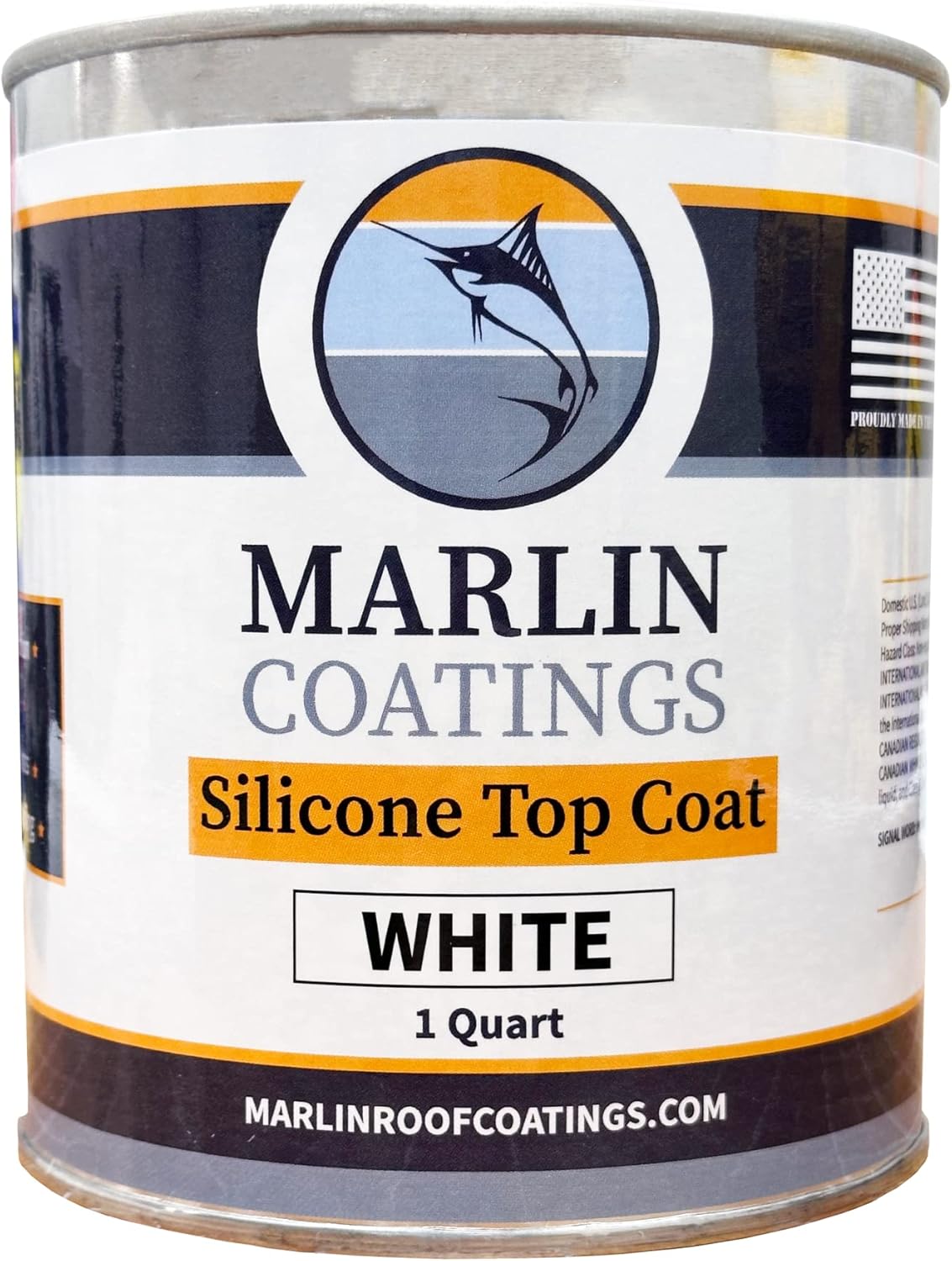
2. Marlin 100% Silicone Roof Sealant
Best For: Large-Scale Waterproofing Projects
Marlin offers another top-tier 100% silicone option that provides outstanding performance at a slightly lower price point than our top pick. It shares many of the same benefits: superior waterproofing, excellent UV protection, and long-lasting flexibility. One of its standout features is its self-leveling property, which helps create a smooth, even surface that fills in small cracks and imperfections as you apply it. This makes the application process a bit more forgiving for DIYers. It’s an ideal choice for large residential flat roofs, RVs, or commercial buildings where performance and ease of use are paramount.
Technical Specifications
| Price | ~$90.90 (excellent value for pure silicone) |
| Type | 100% Silicone with self-leveling properties |
| Coverage | Approx. 100 sq. ft. per gallon at 20 mils thickness |
| Key Features | Self-leveling, waterproof, long-lasting, UV resistant |
| Solar Reflectance | Initial: 88%, After 3 years: 85% (excellent retention) |
| Application Methods | Brush, roller, or airless spray (0.035″ tip minimum) |
Project Scalability Features
Designed for commercial-scale applications with features including:
- Batch Consistency: Manufacturing process ensures color and viscosity consistency across batches for large projects
- Extended Pot Life: 4-hour working time after mixing for spray applications
- Low VOC Formulation: Meets all national and California air quality standards
- Moisture-Tolerant: Can be applied to damp (not wet) surfaces in time-sensitive situations
- Temperature Adaptive: Viscosity adjusts to application temperature for consistent coverage
- Recoat Window: 2-48 hours (extended window benefits large projects)
- Excellent UV protection and waterproofing performance
- Self-leveling formula simplifies application and creates smooth finish
- Adheres well to a variety of surfaces including metal, concrete, and single-ply membranes
- Great value for a pure silicone product with commercial-grade performance
- Can be applied in temperatures from 40°F to 140°F substrate temperature
- Excellent ponding water resistance (30+ days immersion tested)
- May require two coats for optimal thickness on porous surfaces
- Slightly less coverage than some competitors (plan for 10% extra)
- Self-leveling property requires careful application on sloped surfaces
- Limited color selection compared to acrylic systems
- Surface must be properly prepared for optimal adhesion
- Not recommended for vertical surfaces due to self-leveling properties
Large Project Application Strategy
For Projects Over 1,000 sq ft: Use airless spray equipment with proper tip size. Divide roof into manageable sections (approximately 500 sq ft each). Maintain wet edge between sections. Use walk boards to avoid disturbing freshly applied coating.
Quality Control: Check wet film thickness every 200 sq ft using mil gauge. Maintain consistent pressure and speed with spray equipment. Have backup equipment available for large projects.
3. Ames Maximum Stretch Roof Coating & Sealant

Best For: Covering Large Areas with High Flexibility
Ames Maximum Stretch is a high-performance elastomeric coating with an astounding 650% elongation. This incredible flexibility makes it one of the best choices for roofs that experience significant temperature swings, such as metal or membrane roofs. It moves with your roof, preventing cracks and splits from forming. It’s a non-toxic, water-based formula that’s easy to apply and provides excellent adhesion. While it’s a fantastic waterproofer, its real strength lies in its ability to bridge gaps and remain flexible for years. It’s also a great option for sealing around difficult protrusions like vents and HVAC units.
| Price | ~$43.31 (outstanding value for performance) |
| Type | Elastomeric / Rubberized with 650% elongation |
| Coverage | Up to 100 sq. ft. per gallon at recommended thickness |
| Key Features | 650% elongation, waterproof, UV-resistant, water-based |
| Temperature Flexibility | Remains flexible from -20°F to 180°F |
| Drying Time | Touch dry: 2-4 hours; Full cure: 48-72 hours |
Elastomeric Performance Analysis
The 650% elongation rating is exceptional—most residential elastomeric coatings offer 300-400%. This means the coating can stretch 6.5 times its original length without tearing, making it ideal for:
- Metal Roof Expansion: Metal expands approximately 1/8″ per 10′ per 100°F temperature change
- Structural Movement: Accommodates building settlement and wind deflection
- Crack Bridging: Can bridge cracks up to 1/8″ without reinforcement
- Seam Movement: Perfect for sealing moving joints and seams
- Unmatched flexibility (650% elongation) prevents cracking in extreme conditions
- Excellent waterproofing and weather resistance for various climates
- Environmentally friendly water-based formula with low VOCs
- Great value for its performance—premium elasticity at mid-range price
- Easy application with brush, roller, or spray equipment
- Excellent adhesion to metal, concrete, wood, and single-ply membranes
- Can be tinted to match existing roof colors
- Resists mildew and algae growth
- Longer drying and curing time compared to solvent-based products (plan for 48+ hours)
- May require multiple coats for best results on highly porous surfaces
- Not suitable for application in temperatures below 50°F
- Lower UV reflectivity than silicone coatings (typically 80-85%)
- Water-based formula requires careful weather planning
- May show application marks if not applied evenly
Metal Roof Application Protocol
Critical Preparation: Metal roofs require thorough cleaning to remove oxidation, oils, and contaminants. Use trisodium phosphate (TSP) solution followed by thorough rinsing. Apply metal primer to rusted areas.
Application Technique: Apply in two cross-directional coats. First coat: vertical application. Second coat (after 4-6 hours): horizontal application. This ensures complete coverage and uniform thickness.
Special Considerations: Pay extra attention to seams, fasteners, and penetrations. Consider using reinforcing fabric at high-stress areas.
4. Gorilla Waterproof Patch & Seal Liquid Rubber

Best For: Quick Fixes and Sealing Small Areas
Sometimes you don’t need to coat an entire roof; you just need to fix a stubborn leak around a flashing, gutter, or vent pipe. That’s where Gorilla Waterproof Patch & Seal excels. This thick, rubberized liquid can be brushed on to create an instant, durable, and fully waterproof seal. It self-levels and smoothly fills small gaps and cracks. It’s incredibly versatile, sticking to metal, asphalt, concrete, and more. While its small container size makes it impractical for large-scale projects, every homeowner should have a can on hand for emergency repairs. It’s the perfect tool for stopping a small problem before it becomes a major one.
| Price | ~$28.60 (pint size, ideal for repairs) |
| Type | Rubberized liquid sealant |
| Coverage | Small areas (approximately 20-30 linear feet of 1/4″ bead) |
| Key Features | Seals water, air, and moisture; paintable; self-leveling |
| Working Time | 15-20 minutes before skin forms |
| Full Cure | 24-48 hours depending on temperature and humidity |
Emergency Repair Applications
This product excels in specific emergency situations:
- Flashlight Test Repairs: Apply at night when leaks are visible with flashlight from attic
- Storm Preparation: Temporary seal before major storms when professional repair isn’t possible
- RV and Mobile Home Repairs: Excellent for flexible roof materials on recreational vehicles
- Gutter and Downspout Sealing: Creates waterproof seals at connections and seams
- Window and Door Flashing: Seals between dissimilar materials where movement occurs
- Creates a very strong, durable seal that withstands extreme weather
- Extremely easy to apply with a brush—no special tools needed
- Dries quickly for fast repairs (surface dry in 15-30 minutes)
- Sticks to almost any surface: metal, wood, concrete, glass, masonry
- Paintable after full cure (24-48 hours) with oil or latex paints
- Excellent for irregular surfaces and hard-to-reach areas
- Remains flexible after curing to accommodate movement
- Water-based cleanup before drying
- Not cost-effective for large roof areas (designed for spot repairs)
- Strong odor during application—requires ventilation
- Limited working time once applied (15-20 minutes)
- Not designed for continuous water immersion
- Temperature sensitive during application (50°F-90°F recommended)
- Can be messy if not applied carefully
- Not suitable for high-pressure water situations
Professional Repair Techniques
For Leaking Flashing: Clean area thoroughly with wire brush. Apply first coat into the gap. Let dry 1 hour. Apply second coat extending 2″ beyond first coat. Feather edges for smooth transition.
For Crack Repairs: Widen crack slightly with triangular can opener. Clean with compressed air. Apply product with putty knife, forcing into crack. Overfill slightly, then smooth with wet finger or tool.
5. Geocel 4500 Roof Sealant

Best For: Sealing Small Cracks and Joints
The Geocel 4500 is a high-performance caulk-style sealant that comes in a standard cartridge. It’s not for coating a roof but for sealing specific joints, seams, and cracks with surgical precision. It’s a polyether-based formula that provides incredible bonding strength and flexibility. Unlike silicone caulk, it won’t attract dirt and will not yellow over time. It can even be applied to damp surfaces, making it invaluable for emergency repairs during uncertain weather. It’s perfect for sealing around chimney flashing, skylights, and vents.
| Price | ~$27.78 (10.1 oz cartridge) |
| Type | Polyether-based caulking sealant |
| Coverage | Approximately 30-40 linear feet per cartridge (1/4″ bead) |
| Key Features | Non-yellowing, UV-resistant, applies to damp surfaces |
| Movement Capability | ±25% joint movement accommodation |
| Temperature Range | Application: 40°F-100°F; Service: -40°F to 180°F |
Professional Caulking Applications
Geocel 4500 is specifically engineered for critical sealing applications:
- Chimney Flashing: Seals between chimney masonry and roof flashing
- Skylight Perimeters: Flexible seal that accommodates thermal movement
- Vent Pipe Collars: Creates waterproof seal around pipe penetrations
- Ridge and Hip Seams: Seals where roof planes meet
- Eave and Rake Edges: Protects vulnerable edges from wind-driven rain
- Valley Flashing: Seals metal valleys to roof surface
- Exceptional bonding strength to most roofing materials
- Remains flexible and weather-resistant for years
- Can be applied in a wide range of temperatures (40°F-100°F)
- Does not attract dirt like silicone caulk (maintains clean appearance)
- Non-yellowing formula maintains appearance over time
- Can be applied to damp surfaces (not standing water)
- Paintable after 24-hour cure time
- Excellent UV resistance for exposed applications
- Only suitable for sealing joints, not for coating surfaces
- Higher cost per ounce compared to standard caulks
- Requires caulking gun and some skill for professional results
- Limited color options (typically white, black, gray, clear)
- Not designed for submerged or continuously wet conditions
- Skin forms quickly in hot, dry conditions
Professional Caulking Technique
Tool Selection: Use high-quality caulking gun with smooth trigger action. Cut tip at 45° angle to match joint size. Use backer rod in joints deeper than 1/2″.
Application Method: Hold gun at 45° angle to surface. Apply steady pressure while moving gun at consistent speed. Tool joint immediately with wet finger or caulking tool for professional finish.
Joint Design: For best results, joints should be between 1/4″ and 1/2″ wide. Depth should be 1/2 the width for proper performance.
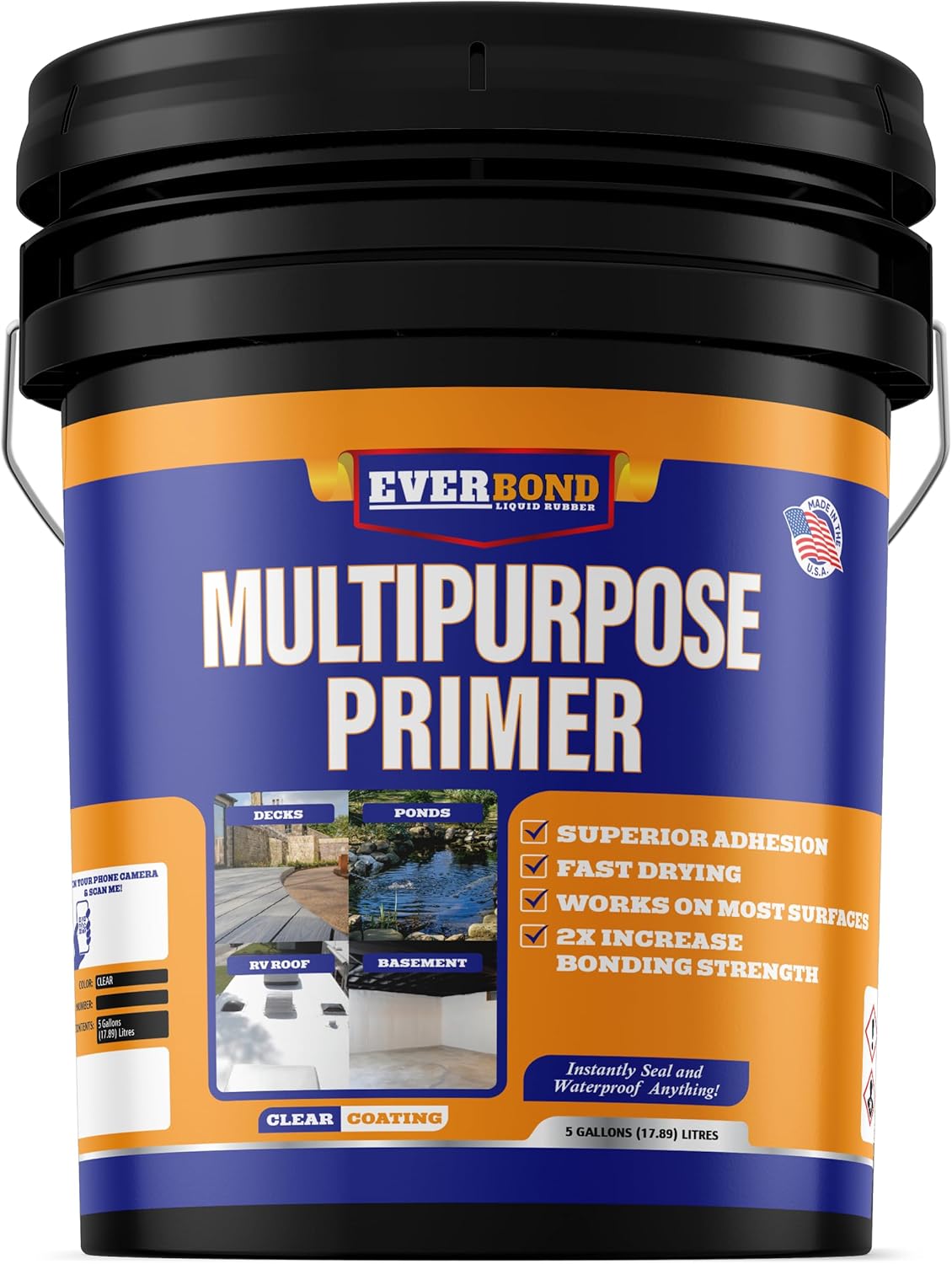
6. Multipurpose Primer for Roof Coatings
Best For: Ensuring Maximum Adhesion and Longevity
A multipurpose primer is the unsung hero of a successful roof coating project. It’s a thin, adhesive layer that promotes bonding between the roof surface and the topcoat. This is especially crucial for slick or weathered surfaces like aged metal, TPO, or previously coated roofs. This primer creates a uniform, stable substrate, ensuring your expensive silicone or elastomeric topcoat sticks permanently. It also helps block stains and rust from bleeding through the final finish. While the price might seem high for a product you’ll cover up, using a primer can double the effective lifespan of your topcoat, saving you significant money in the long run.
| Price | ~$29.77 (essential for professional results) |
| Type | Acrylic-based bonding primer |
| Coverage | Approx. 100-200 sq. ft. per gallon depending on surface porosity |
| Key Features | Bonds to wood, concrete, metal, fiberglass; enhances topcoat adhesion |
| Drying Time | Touch dry: 1-2 hours; Recoat: 2-4 hours |
| Compatibility | Compatible with acrylic, silicone, and elastomeric topcoats |
When Primer is Non-Negotiable
Professional roofers insist on primer in these situations:
- Glossy Surfaces: Previously painted or coated roofs with gloss finish
- Chalky Surfaces: Aged coatings with significant chalk residue
- Metal Roofs: All metal surfaces require primer for optimal adhesion
- TPO/EPDM Membranes: Synthetic rubber membranes need specialized primers
- Concrete and Masonry: Porous surfaces that can wick moisture
- Stain Blocking: Prevents tannin, rust, or smoke stains from bleeding through
- Previously Failed Coatings: When repairing areas of delamination or blistering
- Dramatically improves topcoat bonding (adhesion improvement: 300-400%)
- Provides an extra layer of protection against moisture and stains
- Flexible formula that moves with substrate and topcoat
- Essential for certain roof materials and conditions
- Seals porous surfaces, reducing topcoat absorption and saving material
- Creates uniform surface for consistent topcoat appearance
- Can extend topcoat lifespan by 50-100% when properly used
- Low VOC formulation with minimal odor
- Adds an extra step and cost to the project
- Is not a standalone sealant; requires a topcoat
- Requires proper surface preparation before application
- Limited working time once mixed (typically 2-4 hours)
- Temperature sensitive during application and curing
- Additional drying time adds to project timeline
- Can be messy if not applied carefully
Professional Priming Protocol
Surface Testing: Conduct adhesion test before priming. Apply tape to cleaned surface, press firmly, then rip off quickly. If material comes off, primer is required.
Application Method: Apply with roller or brush at recommended coverage rate. Don’t over-apply—primer should be thin, even film. Pay special attention to edges and seams.
Timing: Apply topcoat within primer’s recoat window (typically 2-24 hours). Beyond this window, surface may need re-cleaning.
7. LR Liquid Rubber Waterproof Sealant

Best For: All-Purpose Budget Sealing
For a versatile and budget-friendly option, LR Liquid Rubber is a fantastic choice. This is a water-based, environmentally friendly sealant that is easy to apply with a simple brush or roller. While not designed for coating an entire exposed roof, it’s perfect for sealing foundations, sheds, basements, and for detailed work like sealing seams, joints, and small cracks on a roof before applying a topcoat. It creates a strong, flexible waterproof membrane and is a great multi-purpose sealant to have on hand for various projects around the home.
| Price | ~$21.95 (excellent value for multipurpose use) |
| Type | Liquid Rubber / Bitumen Modified emulsion |
| Coverage | Approx. 50-75 sq. ft. per gallon at recommended thickness |
| Key Features | Water-based, non-toxic, easy application, paintable |
| Elongation | 300-400% (good flexibility for budget product) |
| Drying Time | Touch dry: 1-2 hours; Full cure: 24-48 hours |
Multipurpose Applications
LR Liquid Rubber shines in these diverse applications:
- Foundation Waterproofing: Interior and exterior foundation walls
- Planter Boxes and Ponds: Creates flexible waterproof liner
- RV and Trailer Roofs: Lightweight protection for mobile applications
- Basement Walls: Interior waterproofing membrane
- Concrete Balconies and Decks: Waterproofing before finish coating
- Pipe Penetrations: Seals around plumbing and electrical penetrations
- Gutters and Downspouts: Repairs and seals metal or plastic components
- Very affordable price point for budget-conscious projects
- Easy to apply with a brush or roller—no special equipment needed
- Environmentally friendly and safe for indoor use (low odor)
- Good adhesion to many different surfaces: concrete, wood, metal
- Paintable after full cure with most exterior paints
- Water-based cleanup makes application and cleanup easy
- Non-toxic formula safe for use around children and pets
- Remains flexible to accommodate substrate movement
- Not designed for large, fully exposed roof surfaces
- Lower UV resistance than silicone or elastomeric topcoats
- Requires multiple coats for adequate thickness (3+ coats recommended)
- Not suitable for ponding water or high-pressure situations
- Limited temperature range for application (50°F-90°F)
- Lower durability compared to premium roof coatings
- Not recommended for horizontal surfaces with foot traffic
- May require more frequent reapplication than specialized products
Best Practices for Application
Multiple Coat Strategy: Apply minimum of three thin coats rather than one thick coat. Allow each coat to dry completely (2-4 hours) before applying next coat. Cross-directional application (vertical then horizontal) ensures complete coverage.
Surface Preparation: Surface must be clean, dry, and sound. Remove all loose material, dirt, and contaminants. Apply to slightly damp surfaces if necessary, but not wet.
Reinforcement: For cracks wider than 1/8″, use reinforcing fabric embedded between coats. This significantly improves durability and crack bridging capability.
Professional Application Techniques: Step-by-Step Mastery
Proper application accounts for 70% of sealant performance. This comprehensive guide covers professional techniques often missed in basic instructions.
Surface Preparation: The Foundation of Success
Step 1: Comprehensive Roof Inspection
Before any cleaning or preparation, conduct a thorough inspection:
- Structural Assessment: Check for sagging, uneven planes, or structural issues
- Moisture Detection: Use infrared camera or moisture meter to identify wet areas
- Material Evaluation: Assess roof material condition and compatibility
- Problem Area Identification: Mark all leaks, cracks, blisters, and deteriorated areas
- Photographic Documentation: Take before photos for warranty and comparison
Step 2: Debris and Contaminant Removal
Professional cleaning protocol:
- Dry Removal: Use soft-bristle broom or leaf blower for loose debris
- Biological Growth: Apply EPA-registered biocide for moss, algae, or fungus
- Oil and Grease: Use degreaser for mechanical or kitchen exhaust areas
- Rust Stains: Apply oxalic acid or commercial rust remover for metal roofs
- Chalking: Remove with stiff brush or power washing (max 300 psi)
Step 3: Repair and Preparation
Address all defects before sealing:
- Crack Repair: Widen cracks to 1/4″ and fill with appropriate sealant
- Blister Repair: Cut out blisters, dry substrate, and patch with compatible material
- Flashing Replacement: Replace deteriorated flashings with new, properly installed ones
- Fastener Inspection: Tighten or replace loose fasteners on metal roofs
- Edge Securing: Ensure all roof edges are properly secured
Step 4: Priming Strategy
Professional priming approach:
- Adhesion Testing: Conduct tape test to determine primer necessity
- Selective Priming: Prime only areas that need it, not necessarily entire roof
- Proper Application: Apply primer at recommended rate with appropriate tools
- Drying Verification: Ensure primer is completely dry before topcoat application
- Timing: Apply topcoat within primer’s specified recoat window
Climate-Specific Application Strategies
Hot & Dry Climates
- Application Time: Early morning before heat buildup
- Surface Temperature: Keep below 120°F during application
- Product Selection: High UV-resistant silicones preferred
- Special Considerations: Watch for rapid skin formation and poor leveling
- Curing Protection: May need misting to slow cure in extreme heat
Cold & Wet Climates
- Application Time: Midday during warming trend
- Temperature Minimum: Most products require 40°F and rising
- Product Selection: Fast-drying acrylics or cold-application formulas
- Special Considerations: Monitor dew point—apply only when surface temperature is 5°F above dew point
- Curing Protection: May need temporary covers or heaters
Humid Subtropical
- Application Time: Late morning after dew evaporates
- Humidity Limit: Most products require below 85% RH
- Product Selection: Mildew-resistant formulations essential
- Special Considerations: Watch for afternoon thunderstorms—plan accordingly
- Curing Protection: Ensure adequate ventilation under roof coating
Climate-Specific Product Recommendations
| Climate Zone | Recommended Products | Critical Features Needed | Application Tips |
|---|---|---|---|
| Desert/Southwest (High UV, Low Rain) |
1. Countryman Silicone 2. Marlin Silicone |
UV resistance >90% Heat reflection Dust resistance |
Apply early morning Cool surface first Expect rapid curing |
| Pacific Northwest (High Rain, Moderate Temps) |
3. Ames Elastomeric 5. Geocel 4500 |
Mildew resistance Fast rain resistance Low-temp flexibility |
Watch weather windows Apply during dry spells Ensure proper drainage |
| Southeast/Gulf Coast (High Humidity, Hurricanes) |
1. Countryman Silicone 3. Ames Elastomeric |
Wind uplift resistance Mold/mildew resistance Fast curing |
Avoid hurricane season Check storm forecasts Reinforce edges |
| Midwest/Great Plains (Extreme Temps, Hail) |
3. Ames Elastomeric 1. Countryman Silicone |
Temperature flexibility Hail resistance Freeze-thaw durability |
Spring or fall application Avoid temperature extremes Consider hail guards |
| Northeast/New England (Snow, Ice, Freeze-Thaw) |
3. Ames Elastomeric 6. Multipurpose Primer |
Ice dam resistance Low-temp flexibility Salt resistance (coastal) |
Summer application only Address ice dam areas first Ensure proper insulation |
Cost Analysis & Return on Investment
Understanding the true cost of roof sealing requires looking beyond the initial purchase price. This analysis considers material costs, labor, energy savings, and increased property value.
| Product | Material Cost per 1000 sq ft | Expected Lifespan | Annual Energy Savings* | 5-Year ROI | Best Value For |
|---|---|---|---|---|---|
| Countryman Silicone | $1,100 – $1,400 | 15-20 years | $200 – $300 | 142% | Long-term owners, premium protection |
| Marlin Silicone | $900 – $1,100 | 12-15 years | $180 – $260 | 128% | Large roofs, commercial applications |
| Ames Elastomeric | $430 – $550 | 8-12 years | $150 – $220 | 115% | DIYers, metal roofs, budget-conscious |
| Gorilla Patch | N/A (spot repairs) | 3-5 years | $0 | 40% | Emergency repairs, small areas |
| Geocel 4500 | N/A (linear feet) | 7-10 years | $0 | 60% | Joint sealing, detailed work |
| Multipurpose Primer | $200 – $300 | N/A (enhances topcoat) | Increases topcoat ROI | 25%** | Problem surfaces, professional results |
| LR Liquid Rubber | $220 – $350 | 5-7 years | $80 – $120 | 85% | Multipurpose, budget projects |
*Based on average cooling cost savings for reflective coatings in moderate climate zones. Actual savings vary by location, roof color, insulation, and energy costs.
**Primer ROI calculated as percentage increase in topcoat lifespan and performance.
Hidden Financial Benefits
- Insurance Premium Reductions: Some insurers offer 5-15% discounts for roofs with documented maintenance and reflective coatings
- Increased Property Value: A well-maintained roof with transferable warranty can increase home value by 2-4%
- Extended Roof Life: Proper sealing can delay full roof replacement by 5-10 years, saving $8,000-$20,000
- Tax Credits and Rebates: Energy-efficient “cool roof” coatings may qualify for local utility rebates or federal tax credits
- Faster Home Sales: Homes with recently maintained roofs sell 15-30% faster than those needing roof work
Maintenance Schedule & Troubleshooting Guide
A proactive maintenance approach extends sealant life and prevents small problems from becoming major repairs.
Proactive Maintenance Schedule
Monthly (5-10 minutes)
- Visual inspection from ground with binoculars
- Check gutters for sealant granules or unusual debris
- Note any visible changes in roof appearance or color
- Document findings in maintenance log
Seasonal (30-60 minutes per season)
- Spring: Inspect for winter damage, clean gutters, check for moss/algae
- Summer: Check for UV degradation, inspect flashings, clean debris
- Fall: Prepare for winter, clear leaves, inspect drainage
- Winter: Check for ice dams, monitor heavy snow loads
Annual Professional Inspection (Every 1-2 years)
- Infrared moisture scan to detect hidden problems
- Adhesion testing at multiple locations
- Thickness measurement with mil gauge
- Comprehensive documentation for warranty compliance
- Professional cleaning if biological growth exceeds 10% coverage
5-Year Comprehensive Maintenance
- Complete surface cleaning and preparation
- Spot repairs and recoating of high-wear areas
- Full performance evaluation against baseline measurements
- Warranty validation and renewal documentation
- Consider complete recoat if coating shows significant deterioration
Troubleshooting Common Problems
| Problem | Likely Cause | Immediate Action | Long-Term Solution |
|---|---|---|---|
| Blistering/Bubbling | Moisture trapped under coating Improper surface preparation |
Cut blister, allow to dry Apply Gorilla Patch temporarily |
Remove affected area Properly dry substrate Reapply with primer |
| Cracking/Alligatoring | Coating too thick Low flexibility product Substrate movement |
Clean cracks, apply Geocel 4500 | Remove old coating Apply high-elongation product like Ames Consider expansion joints |
| Peeling/Flaking | Poor adhesion Surface contamination Incompatible products |
Remove loose material Clean area thoroughly |
Test adhesion Apply proper primer Use compatible topcoat |
| Discoloration/Fading | UV degradation Dirt accumulation Biological growth |
Clean with appropriate cleaner | Apply UV-resistant silicone Consider lighter colors Add algaecide to maintenance |
| Ponding Water | Poor drainage Roof sagging Clogged drains |
Remove standing water Clear drainage paths |
Improve roof slope Install additional drains Use ponding-water resistant silicone |
Frequently Asked Questions: Expert Answers
The frequency depends on several factors:
- Product Type: Silicone: 10-20 years; Acrylic: 5-10 years; Elastomeric: 8-12 years
- Climate: Harsh climates (high UV, extreme temps) require more frequent application
- Roof Exposure: South-facing slopes degrade faster than north-facing
- Maintenance Level: Well-maintained coatings last significantly longer
Professional Recommendation: Inspect annually and plan for recoating when the coating shows:
- Loss of reflectivity (darker appearance)
- Visible cracking or checking
- Reduced flexibility (cracks when bent)
- Significant dirt accumulation that won’t clean off
- More than 10% surface deterioration
Yes, but with important considerations:
DIY-Friendly Products: Ames Elastomeric, Gorilla Patch, and LR Liquid Rubber are designed for DIY application with basic tools.
Professional Products: Countryman and Marlin Silicones require more skill and proper equipment for optimal results.
Safety First: Roof work is dangerous. Never work alone. Use proper fall protection (harness, anchor points). Wear non-slip shoes. Check weather forecast.
Skill Assessment: Be honest about your abilities:
- Beginner: Spot repairs with Gorilla Patch or LR Liquid Rubber
- Intermediate: Small roof areas with Ames Elastomeric
- Advanced: Full roof coating with silicone products
When to Hire a Professional:
- Roof pitch over 6:12 (steep)
- Multiple layers of existing coating
- Extensive repairs needed
- Warranty requirements specify professional application
- Large area (over 1,000 sq ft)
Metal roofs require specific considerations:
Top Recommendations:
- Ames Maximum Stretch: Best overall for residential metal roofs with 650% elongation
- Countryman Silicone: Best for commercial metal roofs or extreme conditions
- Geocel 4500: Best for sealing seams, fasteners, and flashings
Critical Metal Roof Considerations:
- Thermal Expansion: Metal expands/contracts significantly—need high elongation
- Galvanic Corrosion: Ensure sealant doesn’t cause dissimilar metal corrosion
- Surface Preparation: Metal requires thorough cleaning and often priming
- Fastener Sealing: Every fastener must be properly sealed
- Seam Treatment: Pay special attention to standing seams or lap joints
Application Protocol for Metal:
- Clean with metal-specific cleaner to remove oils and oxidation
- Apply rust-inhibiting primer to any rusted areas
- Seal all fasteners with Geocel 4500 or similar
- Apply elastomeric coating in two cross-directional coats
- Pay extra attention to edges and penetrations
This depends on several critical factors:
When You CAN Recoat:
- Same product type over same product type (silicone over silicone)
- Old coating is in good condition (no peeling, cracking, blistering)
- Proper surface preparation is performed (cleaning, dulling glossy surfaces)
- Adhesion test passes (tape test shows good bonding)
- Compatibility is confirmed with manufacturer
When You CANNOT Recoat:
- Different product types without proper primer (acrylic over silicone)
- Old coating is failing (more than 10% deterioration)
- Multiple layers already exist (check manufacturer limits)
- Moisture problems exist under old coating
- Surface contamination cannot be removed
Professional Recoating Protocol:
- Conduct thorough inspection of existing coating
- Perform adhesion tests in multiple locations
- Clean surface thoroughly with appropriate cleaners
- Repair any damaged areas
- Apply bonding primer if needed (Multipurpose Primer recommended)
- Apply new coating following manufacturer’s instructions
Important Note: Some warranties become void if applied over existing coatings. Always check warranty requirements before proceeding.
Understanding these differences is crucial for proper application:
Dry Time (Tack-Free Time):
- When the surface is no longer sticky to touch
- Typically 2-8 hours depending on product and conditions
- Light rain may not damage the coating after dry time
- You can walk on the surface carefully
- Dust and insects won’t stick to the surface
Cure Time (Full Cure):
- When the coating has reached maximum strength and properties
- Typically 24-72 hours for most products
- Coating can withstand full weather exposure
- Maximum adhesion and flexibility achieved
- Chemical resistance fully developed
Product-Specific Times:
| Product | Dry Time | Full Cure |
| Countryman Silicone | 4-6 hours | 7 days |
| Ames Elastomeric | 2-4 hours | 48-72 hours |
| Gorilla Patch | 15-30 minutes | 24-48 hours |
| LR Liquid Rubber | 1-2 hours | 24-48 hours |
Factors Affecting Cure Time:
- Temperature: Higher temperatures speed cure, lower temperatures slow it
- Humidity: High humidity slows water-based products, affects solvent-based differently
- Thickness: Thicker applications take longer to cure throughout
- Ventilation: Good airflow speeds cure for solvent-based products
- Sunlight: UV exposure can speed or hinder depending on product
Final Recommendations: Matching Products to Your Specific Needs
| Homeowner Profile | Primary Need | 1st Choice | 2nd Choice | Budget Range |
|---|---|---|---|---|
| Premium Protection Seeker (Long-term homeowner) |
Maximum longevity, energy savings, warranty | Countryman 100% Silicone | Marlin 100% Silicone | $1,000-$1,500 (per 1000 sq ft) |
| Value-Conscious DIYer (Handy homeowner, moderate budget) |
Good protection, ease of application, versatility | Ames Maximum Stretch | LR Liquid Rubber | $400-$700 (per 1000 sq ft) |
| Repair-Focused (Emergency fixes, spot repairs) |
Quick fixes, small areas, emergency preparedness | Gorilla Waterproof Patch | Geocel 4500 | $20-$50 (per repair kit) |
| Professional or Commercial (Large projects, business property) |
Large area coverage, professional results, durability | Marlin Silicone with Multipurpose Primer |
Countryman Silicone with Multipurpose Primer |
$1,200-$1,800 (per 1000 sq ft with primer) |
| First-Time Roofer (Learning, small projects) |
Easy application, forgiveness, learning curve | LR Liquid Rubber | Ames Elastomeric | $200-$500 (per 1000 sq ft) |