Home » The 5 Best Roof Harnesses of 2026: A Professional’s Guide to Staying Safe at Height
best roof harnesses of 2026

The 5 Best Roof Harnesses of 2026: A Comprehensive Guide to Fall Protection Mastery

On any job site, there are tools that improve efficiency and tools that save lives. A roofing harness falls squarely and indisputably in the latter category. It is the single most important piece of personal protective equipment (PPE) for anyone working at height. There are no second chances when a fall occurs. Gravity is unforgiving, and the difference between a scary moment and a tragic accident often comes down to the quality and proper use of your Personal Fall Arrest System (PFAS), with the harness as its core component.

As a professional who has spent thousands of hours tethered to a lifeline on pitches of all kinds—a different challenge entirely from working on a flat roof—I can tell you this: not all harnesses are created equal. A harness that’s uncomfortable will be worn improperly or, even worse, not at all. A harness made with subpar materials can fail under the extreme force of a fall. This guide is designed to cut through the marketing and focus on what truly matters: certified safety, all-day comfort, and job site durability—essentials for any professional job, especially when insurance is involved and property owners are concerned about what happens if they don’t use the money to fix the roof.

⚠️

A Critical Note on Safety & Training

This guide is for informational purposes only and is not a substitute for professional, site-specific fall protection training (such as OSHA-compliant courses). Always inspect your harness and full fall arrest system before each use, just as you would use the best drone for roof inspections to assess a roof’s condition before stepping on it. If a harness has been subjected to a fall, it must be removed from service immediately. Your life is worth more than any piece of equipment—prioritize proper training and regular inspections.

The Physics of Falls: Understanding What Your Harness Must Withstand

To truly appreciate the engineering behind a quality roof harness, one must understand the extreme forces involved in a fall. When you’re working at height, whether on a sloped roof or a flat roof in hurricane territory, the physics are brutal and unforgiving.

Force Calculations During a Fall

The force exerted on a harness during fall arrest is calculated using this formula:

F = m × a (where F = force, m = mass, a = acceleration/deceleration)

But in practical fall arrest terms, we calculate the arrest force:

Arrest Force (lbs) = (Weight of Worker + Tools) × Fall Factor × Deceleration Factor

Example Calculation:

  • Worker weight: 200 lbs
  • Tools/equipment: 30 lbs
  • Total weight: 230 lbs
  • Fall factor 1.0 (free fall of 6 feet with 6 feet of lanyard)
  • Deceleration factor: 3.5 (typical for energy-absorbing lanyards)

Arrest Force = 230 × 1.0 × 3.5 = 805 pounds

This 805-pound force is what your harness, lanyard, and anchor must withstand INSTANTANEOUSLY. Now consider that OSHA requires harnesses to withstand 5,000 pounds on the dorsal D-ring—that’s a 6:1 safety factor for our example!

The Dangers of Fall Arrest Forces

A fall arrest event, even when “successful,” subjects the human body to extreme trauma:

  • Spinal Compression: Forces can exceed 10 times body weight on the spine
  • Internal Organ Damage: Sudden deceleration can cause internal bleeding
  • Suspension Trauma: Blood pooling in legs when hanging vertically
  • Psychological Trauma: Lasting fear and anxiety after a fall event

This is why proper harness design and fit are critical—they distribute these massive forces safely across the strongest parts of your body.

Material Science Behind Modern Harness Construction

The webbing in your harness isn’t just fabric—it’s engineered material designed to save your life. Understanding these materials helps you make informed decisions about durability, maintenance, and replacement.

Polyester Webbing

Characteristics:

  • Tensile strength: 6,000-9,000 lbs per inch width
  • UV resistance: Excellent (500+ hours before degradation)
  • Abrasion resistance: Very good
  • Chemical resistance: Good against most acids and solvents
  • Moisture absorption: Low (0.4% at 65% humidity)

Best for: General construction, roofing, most outdoor applications

Nylon Webbing

Characteristics:

  • Tensile strength: 7,000-10,000 lbs per inch width
  • UV resistance: Poor (requires UV inhibitors)
  • Abrasion resistance: Excellent
  • Chemical resistance: Good against alkalis
  • Moisture absorption: High (4% at 65% humidity)

Best for: Indoor applications, rescue operations

Specialized Coatings

Common treatments:

  • PU Coating: Waterproofing, additional abrasion resistance
  • Silicone Coating: Extreme temperature resistance
  • Teflon Coating: Chemical resistance, self-cleaning
  • Reflective Strips: Enhanced visibility in low light

Stitching and Sewing Patterns

The stitching in a harness is arguably more critical than the webbing itself. Different stitch patterns serve different purposes:

Stitch Type Strength Retention Common Uses Inspection Indicators
Lock Stitch (301) 85-90% Main structural seams Locking knots visible on backside
Chain Stitch (401) 60-70% Temporary seams, decoration Pulls out easily if broken
Safety Stitch (504) 90-95% Critical load-bearing seams Two parallel stitch lines

Thread Specifications: Quality harnesses use bonded nylon thread (size 69 or 92) with a minimum tensile strength of 8-12 lbs. The thread should be UV-resistant and match the expected service life of the webbing.

Quick Comparison of the Top Roof Harnesses

Product Name Key Feature Compliance Best For Check Price
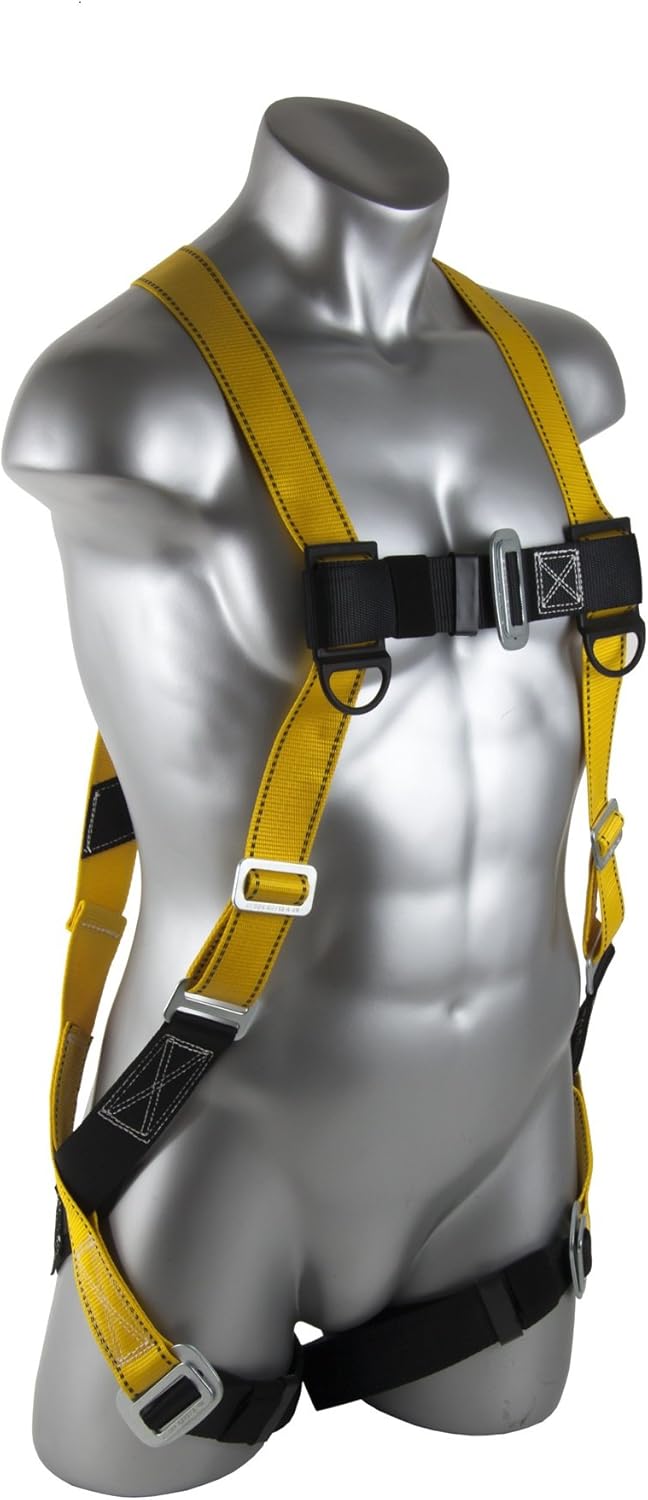
Guardian Velocity Harness Guardian Velocity Harness Lightweight Simplicity OSHA/ANSI All-Around Professional Use View on Amazon
3M Protecta Pro Construction Harness 3M Protecta Pro Construction Trusted Brand & Durability OSHA/ANSI Demanding Daily Use View on Amazon
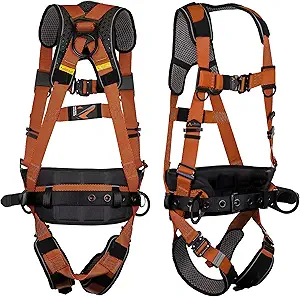
Malta Dynamics Warthog Comfort MAXX Malta Dynamics Warthog Comfort MAXX Exceptional Padding OSHA/ANSI All-Day Comfort View on Amazon
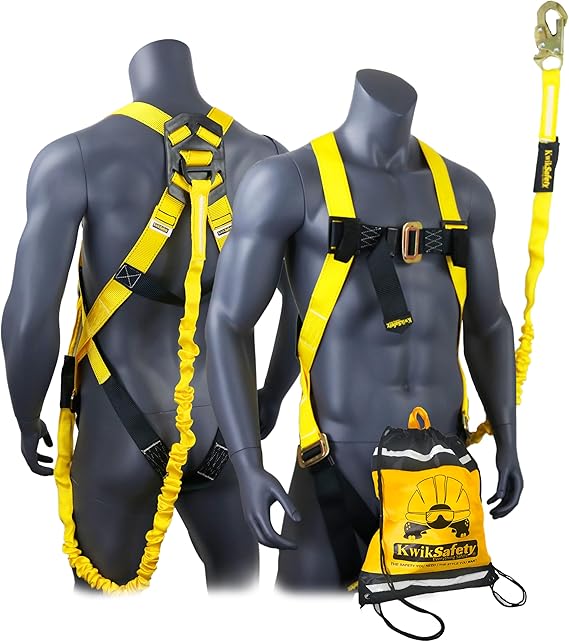
KwikSafety SCORPION Harness KwikSafety SCORPION 3 D-Ring Affordability & Features OSHA/ANSI Best Value & DIYers View on Amazon
Palmer Safety Fall Protection Harness Palmer Safety Full Body Harness Entry-Level Compliance OSHA/ANSI Budget-Conscious Users View on Amazon

Industry-Specific Harness Requirements

Different roofing applications demand different harness features. What works for residential asphalt shingle installation may be inadequate for industrial metal roof work.

Residential Roofing Applications

Asphalt Shingle Installation

Key Challenges:

  • Heat from dark shingles (130°F+ surface temps)
  • Granule abrasion on webbing
  • Asphalt/tar contamination
  • Frequent movement along roof plane

Recommended Features:

  • UV-resistant webbing (minimum 500 hours rating)
  • Abrasion-resistant coatings
  • Breathable padding for heat management
  • Lightweight construction (under 8 lbs)

Tile & Slate Roof Work

Key Challenges:

  • Fragile surface materials
  • Sharp edges on broken tiles
  • Heavy material handling
  • Complex roof geometries

Recommended Features:

  • Cut-resistant webbing (minimum Type 4)
  • Side D-rings for positioning
  • Reinforced padding at contact points
  • Tool attachment loops

Commercial & Industrial Applications

Metal Roof Systems

Working on metal roofs in Florida or other regions presents unique challenges that affect harness selection:

Special Considerations for Metal Roofs:
  • Thermal Expansion: Metal expands significantly in heat, affecting anchor point placement
  • Conductivity: Aluminum or steel webbing can conduct electricity if wet
  • Surface Hardness: Most coatings scratch easily from hardware contact
  • Slipperiness: Metal becomes extremely slippery with morning dew

Essential Features for Metal Roof Harnesses:

  • Non-conductive webbing (nylon preferred over polyester)
  • Protective covers on all metal hardware
  • Chemical resistance for coating application (when you need to paint a metal roof)
  • Integrated tool tethers for dropped object prevention

Industrial Plant Roof Maintenance

Extreme Environment Considerations:

  • Chemical exposure from plant emissions
  • High temperature areas near exhaust systems
  • Confined space entries through roof hatches
  • Atmospheric monitoring requirements

Specialized Harness Features Needed:

  • Chemical-resistant coatings (Teflon or silicone)
  • Heat-resistant webbing (400°F+ rating)
  • Front D-ring for confined space retrieval
  • Attachment points for breathing apparatus

Comprehensive Inspection Protocols: Beyond the Basics

A proper harness inspection is a systematic process that should take 3-5 minutes. Rushing through it defeats the purpose. Here’s the complete professional protocol:

Daily Pre-Use Inspection Checklist

Phase 1: Visual Inspection (2-3 minutes)

  1. Unfold Completely: Lay harness flat on clean surface
  2. Check Webbing: Run entire length through fingers, looking for:
    • Cuts, tears, or abrasions (feel for thin spots)
    • Chemical damage (stiffness, discoloration)
    • UV degradation (fading, brittleness)
    • Heat damage (melting, charring)
  3. Inspect Stitching: Look for:
    • Broken or pulled stitches
    • Loose threads
    • Missing safety stitches
    • Stretched stitch patterns
  4. Check Hardware:
    • D-rings for cracks, deformation, or corrosion
    • Buckles for proper function and wear
    • Grommets for secure attachment
    • All metal parts for sharp edges

Phase 2: Functional Inspection (1-2 minutes)

  1. Test All Buckles: Ensure they latch securely and release properly
  2. Check Adjustment Points: All straps should adjust smoothly
  3. Verify Labels: All required labels should be legible and intact
  4. Test Fall Indicators: Ensure they’re intact (if equipped)

Comprehensive Monthly Inspection

Performed by a “competent person” as defined by OSHA:

Monthly Competent Person Inspection

  • ✓ Complete daily inspection checklist
  • ✓ Measure webbing width at multiple points (compare to original specs)
  • ✓ Check for elongation by comparing to manufacturer’s baseline
  • ✓ Test buckle release force (should be 5-15 lbs)
  • ✓ Verify all warning labels are present and legible
  • ✓ Check for proper documentation of previous inspections
  • ✓ Verify compliance with current ANSI/OSHA standards
  • ✓ Document inspection in equipment log

Advanced Testing Equipment Used by Professionals:

  • Tensile Testers: Measure webbing strength (sample testing only)
  • UV Light Meters: Detect UV degradation before visible
  • Chemical Test Kits: Identify unknown chemical contamination
  • Microscopic Inspection: Detect microfiber damage

Annual Factory-Level Inspection

Some manufacturers offer factory re-certification services:

Guardian Fall Protection
  • Complete disassembly and inspection
  • Ultrasonic testing of webbing
  • Chemical analysis of materials
  • Recertification tagging and documentation
  • Cost: $45-75 per harness
3M Professional Services
  • X-ray inspection of metal components
  • Tensile testing to 50% of rated strength
  • UV degradation analysis
  • Complete cleaning and refurbishment
  • Cost: $60-90 per harness

In-Depth Reviews: The Best Life-Saving Roof Harnesses

Guardian Velocity Full-Body Harness

1. Guardian Velocity Full-Body Harness

Guardian Fall Protection is a name synonymous with job site safety, and the Velocity harness is their workhorse. It strikes an almost perfect balance between comfort, weight, and no-nonsense functionality. The design philosophy here is “everything you need, nothing you don’t.” It features a simple, effective 5-point adjustment system that allows for a secure and customized fit on a wide range of body types.

The webbing is durable, and the stitching is robust, giving you confidence in its construction. One of its best features is its low weight. When you’re already carrying tools and navigating a steep roof, a lightweight harness significantly reduces fatigue. It’s a professional-grade tool designed for the tradesperson who needs reliable, compliant protection every single day.

Compliance: Meets ANSI Z359.11, ANSI A10.32, and all applicable OSHA standards.

What We Liked

  • Excellent balance of performance, weight, and price.
  • Easy to adjust for a secure, custom fit.
  • Lightweight design minimizes fatigue.
  • Durable construction from a highly reputable brand.
  • Includes lanyard keepers to prevent snagging.

What Could Be Improved

  • Minimal padding; may be less comfortable for extended wear than premium models.
  • Standard pass-through buckles can be slower to put on.

Verdict: The Guardian Velocity is our top pick for the all-around professional. It offers uncompromising safety and compliance in a lightweight, durable, and reasonably priced package. It’s the perfect choice for daily use.

3M Protecta Pro Construction Style Harness

2. 3M Protecta Pro Construction Style Harness

When you buy a product from 3M, you’re buying into a legacy of industrial innovation and safety research. The Protecta Pro line is a testament to this, offering a harness that is built to withstand the harshest job site conditions. The polyester webbing is specifically designed to be resistant to abrasion, UV degradation, and chemicals, making it ideal for tough environments like working on metal roofs in Florida, where surfaces can be hot and abrasive. This durability is key for professionals who also handle tasks like needing to paint a metal roof.

The design features a fixed dorsal D-ring to ensure a proper connection angle, and the contrasting colors of the torso and leg straps make it easier to orient and put on correctly—a simple but brilliant safety feature. It feels substantial without being overly heavy, and the strategically placed fall indicator stitches give you a clear visual cue if the harness has been compromised in a fall.

Compliance: Meets ANSI Z359.11 and OSHA 1910.66, 1926.502 standards.

What We Liked

  • Extremely durable, abrasion-resistant webbing.
  • Backed by 3M’s global reputation for safety.
  • Color-coded straps simplify the process of putting it on.
  • Built-in fall indicators for easy inspection.
  • Available with various buckle options (pass-through, tongue, quick-connect).

What Could Be Improved

  • Can be stiffer than other models out of the box.
  • Base model lacks significant padding.

Verdict: For roofers working in demanding environments who need a harness that will stand up to daily abuse, the 3M Protecta Pro is an industry standard. It’s a rugged, reliable choice from a brand that safety managers trust implicitly.

Malta Dynamics Warthog Comfort MAXX Harness

3. Malta Dynamics Warthog Comfort MAXX Harness

If you’ve ever ended a long day with sore shoulders and red marks from harness straps, the Malta Dynamics Warthog Comfort MAXX was designed for you. This harness prioritizes ergonomics above all else. It’s loaded with thick, breathable padding on the shoulders, back, and legs, which makes a world of difference during a 10-hour workday that could involve anything from shingle installation to minor repairs with roofing tape.

But comfort doesn’t mean a compromise on safety. The Warthog is fully compliant and features a robust construction. The quick-connect chest and leg buckles make getting in and out of the harness significantly faster and easier than traditional pass-through buckles. It also includes side D-rings for positioning, adding a layer of versatility for workers who may need them.

Compliance: Meets ANSI Z359.11-2014 and OSHA 1926.502 standards.

What We Liked

  • Exceptional all-day comfort due to extensive padding.
  • Quick-connect buckles are fast and convenient.
  • Breathable padding helps keep you cool.
  • Side D-rings add positioning versatility.
  • Feels like a premium, high-end harness.

What Could Be Improved

  • Heavier and bulkier than non-padded models.
  • Higher price point.

Verdict: If comfort is your number one priority and you’re willing to invest in a harness that feels less like a piece of safety equipment and more like a part of your clothing, the Warthog Comfort MAXX is the undisputed winner.

KwikSafety SCORPION 3 D-Ring Safety Harness

4. KwikSafety SCORPION 3 D-Ring Safety Harness

KwikSafety has carved out a niche by offering fully compliant safety gear at an extremely competitive price point, and the SCORPION harness is a great example. For a price that’s often less than half of the premium brands, you get a fully functional, OSHA/ANSI compliant harness with features often found on more expensive models, such as side D-rings and pass-through leg straps.

This makes it an excellent option for smaller roofing companies looking to outfit their crew without breaking the bank, or for the serious DIYer who needs professional-grade protection for a weekend project. The webbing is a bright, high-visibility color, adding another layer of safety on a busy job site. While it may not have the refined comfort of the Malta Dynamics, it provides certified protection at a price that leaves no excuse for not being tied off.

Compliance: Meets ANSI/ASSE Z359.11-2014 standards.

What We Liked

  • Outstanding value for a fully compliant harness.
  • Includes side D-rings for work positioning.
  • High-visibility color enhances job site safety.
  • Lightweight and straightforward design.
  • Accessible price point for crews and individuals.

What Could Be Improved

  • Less padding and refinement than premium harnesses.
  • Longevity under heavy daily use may be less than top-tier brands.

Verdict: The KwikSafety SCORPION is the best value proposition on the market. It offers certified, no-frills protection that’s perfect for budget-conscious professionals, occasional users, or safety-minded homeowners.

Palmer Safety Full Body Safety Harness

5. Palmer Safety Full Body Harness

For those on the tightest of budgets who still need to meet basic safety compliance, the Palmer Safety harness is a viable entry-level option. It provides the essential framework of a full-body harness—a dorsal D-ring, 5 points of adjustment, and pass-through buckles—all while meeting the necessary OSHA and ANSI standards. It’s a simple, utilitarian design that gets the job done.

This is a harness for the absolute essentials. There’s no padding, no quick-connect buckles, and no extra frills. It’s designed to provide a compliant connection point for your fall arrest system at the lowest possible cost. It’s a suitable choice for short-duration tasks or as a backup harness to have in the work truck.

Compliance: Meets ANSI Z359.11-2014, CSA Z259.10, and OSHA 1926 standards.

What We Liked

  • Extremely affordable and budget-friendly.
  • Fully compliant with all major safety standards.
  • Lightweight and takes up minimal space.
  • Simple, easy-to-understand design.

What Could Be Improved

  • No padding whatsoever; not ideal for all-day use.
  • Basic materials may not hold up as long as premium brands.
  • Can be less comfortable and prone to tangling.

Verdict: The Palmer Safety harness is the go-to for meeting compliance on a shoestring budget. While it lacks comfort for professional daily use, it provides certified protection and is a far safer alternative than working without any fall arrest system.

Complete Fall Arrest System Integration

A harness is useless without a complete Personal Fall Arrest System (PFAS). Understanding how all components work together is essential for true safety.

Anchorage Systems for Roofing

Anchorage Requirements

OSHA 1926.502(d)(15) requires:

  • Strength: 5,000 lbs per attached employee
  • Certification: By qualified person
  • Inspection: Before each use
  • Location: Above dorsal D-ring when attached
Temporary Roof Anchors
  • Permanent vs Temporary: Temporary anchors removed after job
  • Installation Methods: Screw-in, adhesive, weighted
  • Load Capacity: Minimum 5,000 lbs static
  • Spacing: Maximum 25 feet apart
Horizontal Lifeline Systems
  • Types: Cable, rail, rope
  • Span Limits: 100-300 feet depending on system
  • Sag Calculation: Critical for proper function
  • End Anchor Strength: 10,000+ lbs required

Connector Selection and Compatibility

Choosing the Right Lanyard

  1. Determine Fall Distance: Calculate total potential fall (6 ft minimum)
  2. Select Lanyard Type:
    • Shock-Absorbing: Reduces arrest forces to ≤ 900 lbs
    • Self-Retracting: Limits free fall to ≤ 2 feet
    • Rope Grab: For use on vertical lifelines
    • Y-Lanyard: For 100% tie-off during movement
  3. Check Compatibility: Ensure lanyard snap hooks match harness D-ring size
  4. Verify Certification: Must be compatible with harness certification

Snap Hook Compatibility Chart

Hook Type Min D-Ring Size Gate Strength ANSI Classification
Auto-Locking 1.5″ 3,600 lbs Z359.12
Double-Action 1.75″ 5,000 lbs Z359.1
Triple-Action 2.0″ 5,000 lbs Z359.1

Advanced Training and Certification Programs

OSHA-Authorized Training Paths

OSHA 10-Hour Construction

  • Duration: 10 hours (2 days)
  • Cost: $150-250
  • Coverage: Basic fall protection principles
  • Validity: Lifetime (recommended renewal every 5 years)
  • Provider: OSHA Training Institute Education Centers

OSHA 30-Hour Construction

  • Duration: 30 hours (4-5 days)
  • Cost: $400-600
  • Coverage: Comprehensive fall protection systems
  • Validity: Lifetime
  • Required for: Supervisors, safety managers

Competent Person Training

  • Duration: 8-16 hours
  • Cost: $300-500
  • Coverage: Equipment inspection, hazard assessment
  • Validity: 3 years
  • Legal Requirement: For supervising fall protection

Manufacturer-Specific Certifications

Manufacturer Certification Program Duration Cost Specialization
3M Fall Protection Specialist 40 hours $1,200 Industrial applications
Guardian System Installer 24 hours $850 Anchor installation
MSA Advanced Rescue 32 hours $1,500 Rescue operations

Emergency Rescue Planning and Execution

The 15-Minute Rule

OSHA requires that employers have a rescue plan capable of retrieving a fallen worker within 15 minutes of the fall. After 15 minutes of suspension, the risk of suspension trauma increases dramatically.

Rescue System Components

Basic Rescue Procedure

  1. Immediate Response: Call for help, assess situation
  2. Stabilize Victim: Deploy suspension trauma straps
  3. Setup Rescue System: Install anchor, rig mechanical advantage
  4. Rescuer Access: Safely reach victim
  5. Attachment: Connect victim to rescue system
  6. Lowering/Retrieval: Controlled descent to safety
  7. Medical Attention: Immediate assessment upon retrieval
Rescue Equipment Requirements
  • Descent Device: Rated for two-person load
  • Mechanical Advantage: 4:1 or 5:1 system
  • Medical Kit: Trauma-focused with splints
  • Communication: Two-way radios for coordination
  • Backup Systems: Redundant equipment
Team Composition
  • Rescue Team Leader: 1 person
  • Primary Rescuer: 1-2 persons
  • Safety Officer: 1 person
  • Communications: 1 person
  • Medical: 1 person (trained in first aid)

Cost Analysis and Return on Investment

Total Cost of Ownership Calculation

Cost Category Guardian Velocity 3M Protecta Pro Malta Warthog 5-Year Total
Initial Purchase $189 $245 $329 N/A
Annual Maintenance $25 $30 $40 5x annual
Replacement Cycle 3 years 4 years 5 years N/A
Training Cost $45/year $45/year $45/year $225
5-Year Total $464 $545 $634 Comparison

Insurance and Liability Implications

Workers’ Compensation Cost Analysis

Proper fall protection significantly reduces insurance costs:

  • Average Fall Injury Claim: $110,000 (medical + lost time)
  • Fatal Fall Claim: $1.2 million average
  • Premium Reduction: 10-25% for documented safety programs
  • Experience Mod Rate: Can be reduced by 0.15-0.25 points

ROI Calculation Example:

Company with 10 roofers invests $5,000 in harnesses and training:

  • Annual premium reduction: $8,000
  • Reduced injury claims: $25,000 (estimated)
  • Increased productivity: $15,000 (from reduced fatigue)
  • First Year ROI: 960% ($48,000 benefit ÷ $5,000 cost)

Future Trends and Innovations

Smart Harness Technology

Sensing Systems

  • Impact Detection: Automatically alerts after fall
  • Vital Signs Monitoring: Heart rate, body temperature
  • GPS Location: Precise positioning for rescue
  • Suspension Timer: Counts down 15-minute window

Connectivity Features

  • Bluetooth Mesh: Team communication and location
  • Cloud Reporting: Real-time safety data
  • Maintenance Alerts: Predictive replacement scheduling
  • Training Integration: Virtual reality simulations

Material Science Advances

Next-Generation Materials

  • Graphene-Enhanced Webbing: 300% stronger, 50% lighter
  • Self-Healing Polymers: Micro-capsules repair small cuts
  • Phase-Change Padding: Active temperature regulation
  • Biodegradable Options: Reduced environmental impact
  • Conductive Threads: Integrated power and data transfer

Expert Buying Guide: How to Choose a Life-Saving Roof Harness

Your harness is a life-support system. Making an informed choice is critical. Here’s what decades of experience have taught me to look for.

1. Uncompromising Compliance: OSHA & ANSI

This is non-negotiable. Any professional harness must meet or exceed OSHA 1926.502 (the construction industry standard) and ANSI Z359.11 (the standard for full-body harnesses). OSHA sets the law, and ANSI sets the detailed performance standards. Look for these certifications explicitly listed on the product tag. If they aren’t there, don’t buy it.

2. The Anatomy of a Quality Harness

  • Dorsal D-Ring: This is the ring on your back, between your shoulder blades. It is the ONLY connection point that should be used for fall arrest to ensure you remain in an upright position during a fall.
  • Webbing: Look for durable polyester or nylon webbing that is resistant to UV rays and abrasion.
  • Buckles: Pass-through buckles are simple and secure but slow. Tongue buckles are like a standard belt. Quick-connect buckles are the fastest and easiest, but add cost and weight.
  • Fall Indicators: These are specially folded sections of webbing with breakaway stitching. In a fall, the stitches break, providing a permanent, visible indication that the harness must be retired.

3. Fit is Everything: Comfort and Safety

A poorly fitting harness is dangerous and uncomfortable. You should be able to fit a flat hand (but not a clenched fist) between the straps and your body. The chest strap should be positioned in the mid-chest area, and the dorsal D-ring should be centered between your shoulder blades. Never work with twisted straps.

Remember the “ABC’s” of Fall Protection

A harness is only one piece of the puzzle when you’re installing the best roof windows or servicing roof exhaust fans. A complete Personal Fall Arrest System (PFAS) consists of three parts:

  • A for Anchorage: A secure point of attachment (e.g., a certified roof anchor).
  • B for Bodywear: Your full-body harness.
  • C for Connector: A lanyard or self-retracting lifeline that connects your harness to the anchor.

All three components must be present, compatible, and used correctly to ensure your safety.

Advanced Selection Criteria

Body Type Considerations

  • Height Ranges: Ensure harness fits your specific height
  • Weight Capacity: Include tools and clothing in calculations
  • Shoulder Width: Critical for proper force distribution
  • Leg Loop Design: Different designs for different body types

Job-Specific Features

  • Tool Loops: Number and placement for your tools
  • Pouch Compatibility: Attachment points for equipment pouches
  • Radio Loops: For communication equipment
  • ID Holder: For certification cards and identification

Frequently Asked Safety Questions

How often should I inspect my safety harness?

Answer: Every single time before you put it on. This is a requirement by OSHA. You should perform a thorough tactile and visual inspection, checking the entire length of the webbing for cuts, frays, burns, or chemical damage. Check all stitching, and ensure all hardware (D-rings, buckles) is free of cracks, deformities, and functions correctly. A “competent person” should also formally inspect it at least annually.

When does a safety harness expire?

Answer: Most manufacturers recommend removing a harness from service five years after its first use, but this is a guideline, not a strict rule. The absolute rule is this: a harness expires the moment it fails an inspection or is subjected to a fall. Damage, not the date, is the ultimate deciding factor.

What is a suspension trauma relief strap?

Answer: After a fall, a worker is suspended in their harness. The pressure from the leg straps can cut off circulation, leading to a life-threatening condition called suspension trauma. Relief straps are small pouches attached to the harness containing a loop of webbing. The fallen worker can deploy these loops and step into them, using their leg muscles to take the pressure off their arteries and prolong their safe rescue time. They are a small, inexpensive, but potentially life-saving addition.

Advanced Technical Questions

What’s the difference between polyester and nylon webbing for harnesses?

Answer: Polyester has better UV resistance (500+ hours vs 200 hours for nylon), lower moisture absorption (0.4% vs 4%), and better chemical resistance to acids. Nylon has slightly higher tensile strength (10,000 lbs/inch vs 9,000 lbs/inch for polyester) and better abrasion resistance. For roofing applications, polyester is generally preferred due to its superior UV resistance and lower moisture absorption, which prevents mildew and maintains strength in humid conditions.

How do I calculate the exact fall clearance needed for my specific setup?

Answer: Use this formula: Total Fall Clearance = Lanyard Length + Deceleration Distance + Harness Stretch + Safety Factor + Height of Worker. Example: 6 ft lanyard + 3.5 ft deceleration + 1 ft harness stretch + 3 ft safety + 6 ft worker height = 19.5 feet minimum clearance required. Always add an additional 2-3 feet as a safety margin.

Final Verdict: Your Life is Your Most Valuable Tool

Unlike a hammer or a nail gun, your harness is a tool you hope you never have to truly *use*. But if that moment ever comes, whether you slip while inspecting for dangerous roof rats or during a simple repair, your choice will determine the outcome. Your safety, your family’s well-being, and your ability to work tomorrow all depend on it.

  • For the Daily Professional: The Guardian Velocity Harness provides the perfect blend of certified safety, lightweight design, and value for everyday use.
  • For Maximum Comfort: The Malta Dynamics Warthog Comfort MAXX is the clear winner if you spend long hours in your harness and want to minimize fatigue and discomfort.
  • For the Best Value: The KwikSafety SCORPION proves that certified, life-saving protection can be accessible to everyone, from professionals to homeowners.

Invest in a quality, compliant harness. Get the proper training. Inspect your gear rigorously. Your life is not an area where you can afford to cut corners. Stay safe up there.

Complete Fall Protection Mastery Checklist

Pre-Work Planning

  • ✓ Site-specific fall protection plan developed
  • ✓ Competent person identified for supervision
  • ✓ Rescue plan established and practiced
  • ✓ Weather conditions assessed (no work in high winds/lightning)
  • ✓ Communication methods established

Equipment Preparation

  • ✓ Harness inspected (daily pre-use checklist complete)
  • ✓ Lanyard/connector inspected and compatible
  • ✓ Anchor points certified and properly installed
  • ✓ All components within service life and certification
  • ✓ Backup equipment available if needed

Personal Preparation

  • ✓ Proper clothing worn (no loose items that could snag)
  • ✓ Harness fitted correctly (flat hand test passed)
  • ✓ Tools secured with lanyards where appropriate
  • ✓ Communication device accessible
  • ✓ Suspension trauma straps accessible and understood

Affiliate Disclosure: This post contains affiliate links. If you make a purchase through these links, we may earn a small commission at no additional cost to you. This helps us continue to produce in-depth, experience-driven safety and tool reviews. We only recommend products we trust to protect our fellow tradespeople.

Professional Certification Notice: The information in this guide represents comprehensive research and professional experience but does not constitute certified safety training. Always obtain proper training from OSHA-authorized providers and consult with qualified safety professionals for site-specific requirements.

Leave a Comment

Scroll to Top