
Mastering Gambrel Roof Architecture: Maximizing Space in Barns and Modern Homes
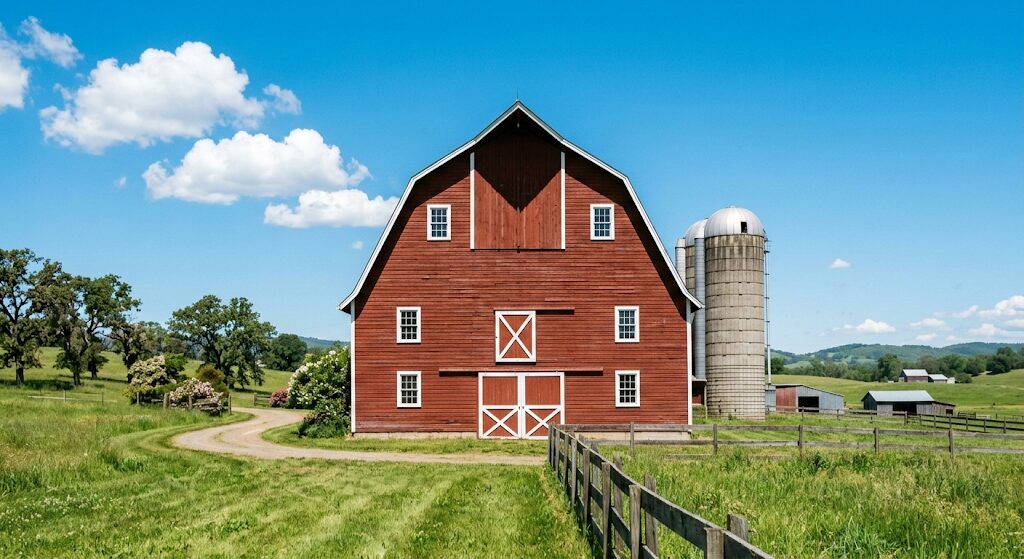
When you picture a quintessential American barn resting in a sprawling pasture, the image that immediately springs to mind is almost certainly a building topped with a gambrel roof. Often colloquially referred to as a “barn roof,” the gambrel design is instantly recognizable by its distinct, symmetrical, two-sloped profile. But this architectural marvel is far more than just a rustic aesthetic choice; it is a masterpiece of structural utility engineered to solve a very specific spatial problem.
The core brilliance of the gambrel roof lies in its ability to maximize usable volume. By featuring a shallow upper slope that aggressively drops into a much steeper lower slope, the design essentially hollows out the attic, providing the headroom of a full second story without the sheer vertical wall height required by traditional framing. Historically, this allowed farmers to store massive quantities of hay. Today, modern architects and homeowners are repurposing this iconic design to create stunning, expansive loft spaces, master suites, and striking residential exteriors.
However, designing, framing, and maintaining a gambrel roof comes with highly specific challenges. The complex dual-pitch geometry affects everything from wind resistance and snow load capacity to the materials you choose and the way you ventilate the structure. In this definitive guide, we will deconstruct the gambrel roof from the rafters to the ridge cap, ensuring you have the expert blueprint needed for your next barn or home construction project.
Gambrel Roofs: Barns vs. Modern Homes
While the exterior silhouette remains the same, the engineering requirements and interior finishing of a gambrel roof change drastically depending on whether it sits atop an agricultural outbuilding or a heated residential home.
The Agricultural Application (Barns & Sheds)
In barns, the gambrel roof is purely utilitarian. The steep lower slope prevents heavy snow accumulation from crushing the structure, while the wide, shallow upper slope acts as an umbrella over a vast, uninterrupted loft. Historically, these lofts were used for hay storage, requiring open spans without vertical support columns getting in the way. Today, gambrel sheds and barns utilize simplified truss systems. Because barns are largely unconditioned spaces, builders don’t have to worry as intensely about complex vapor barriers, rigid insulation codes, or interior drywall finishing. The framing is exposed, rugged, and focused on load-bearing capacity.
The Residential Application (Homes & Garages)
Incorporating a gambrel roof into a residential home—often seen in Dutch Colonial architecture—presents a completely different set of engineering hurdles. The space beneath the roof is no longer a hayloft; it is a bedroom, a bathroom, or a studio. This means the steep lower slope actually functions as an exterior wall for the upper floor. It must be framed to accommodate standard egress windows or dormers to let in natural light.
Furthermore, residential gambrels require meticulous insulation and ventilation. Because the “ceiling” is essentially the roof deck, leaving adequate airflow space between the insulation and the roof sheathing is paramount to prevent ice dams and mold. Builders must adhere to strict building codes, utilizing specialized framing joints to handle the lateral thrust generated by the heavy, insulated, drywall-covered dual pitches.
The Anatomy & Framing Techniques of a Gambrel
The defining characteristic of the gambrel is its geometry. It is a symmetrical roof with two distinct slopes on each side of the central ridge. Understanding how these slopes connect is the key to a successful build.
- The Upper Slope: This is the section closest to the ridge (the peak). It has a shallow pitch, typically ranging from a 3/12 to a 6/12 pitch. Its primary job is to cap the structure and provide a wide umbrella over the space below.
- The Lower Slope: This section drops off aggressively from the upper slope. It is extremely steep, often ranging from an 18/12 to a nearly vertical pitch. This steepness is what creates the vertical wall space for the interior room.
- The Purlin or Knuckle Joint: The most critical structural point of a gambrel roof is where the shallow upper slope meets the steep lower slope. This joint acts as a hinge and is highly susceptible to outward thrust (spreading apart) under the weight of snow or wind.
To safely frame this complex structure, modern builders generally rely on prefabricated Gambrel Trusses. These trusses are engineered in a factory with specialized metal gusset plates that lock the angles together perfectly, transferring the roof load straight down into the exterior walls. If a builder is “stick-framing” (building on-site with individual rafters), they must employ advanced joinery, often utilizing thick collar ties or a structural ridge beam to prevent the walls from bowing outward. If the design includes dormer windows or complex intersections, understanding proper roof valley framing layout and cutting techniques is essential to ensure watertight structural integrity where the different roof planes meet.
Metabo HPT Pneumatic Framing Nailer (NR90AES1)
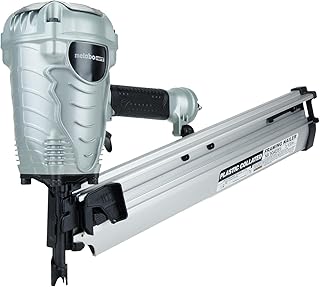
Framing a gambrel roof, especially if you are stick-building the complex knuckle joints and collar ties, requires relentless, heavy-duty fastening. The Metabo HPT (formerly Hitachi) is the legendary standard for roofing and framing contractors. Driving 2-inch to 3-1/2-inch plastic collated framing nails, it offers the raw pneumatic power required to secure dense lumber and gusset plates at awkward angles high above the ground.
Pros
- Incredible driving power for dense, engineered lumber.
- Lightweight at just 7.5 lbs, reducing arm fatigue during steep roof framing.
- Tool-less depth adjustment for precision nailing on joints.
- Open nose design for remarkably easy jam clearance.
Cons
- Requires an air compressor and heavy hose (not cordless).
- Does not come with a rafter hook out of the box (must be purchased separately).
Pros & Cons of Gambrel Design
Before committing to a gambrel roof for your shed, barn, or custom home, it is vital to weigh the architectural benefits against the structural drawbacks.
The Advantages (Pros)
- Maximum Usable Space: This is the defining benefit. A gambrel roof provides almost the exact same square footage in the upper loft/second story as the ground floor, without the material cost of building full two-story vertical walls.
- Cost-Effective Expansion: Because the steep lower roof slope acts as the walls for the upper room, you save significantly on traditional wall framing, exterior siding, and masonry.
- Easy Drainage on the Lower Pitch: The nearly vertical lower slopes shed rain instantly, extending the lifespan of the roofing materials on the sides of the structure.
- Ease of Construction: When utilizing prefabricated trusses, a gambrel roof is actually surprisingly fast and simple for a professional crew to erect compared to complex multi-valley hip roofs.
The Disadvantages (Cons)
- Snow Load Vulnerability: The shallow upper slope of a gambrel roof is prone to holding heavy, wet snow. In extreme northern climates, the trusses must be heavily reinforced to prevent the upper roof from caving in or the outward thrust from bowing the walls.
- Wind Resistance: The steep, tall lower slopes act like massive sails. In hurricane-prone areas, gambrel roofs take the full brunt of lateral wind loads and require significant hurricane ties and structural bracing.
- Maintenance Danger: The lower slope is too steep to walk on safely. Any maintenance, shingle repair, or painting requires extensive scaffolding, roof jacks, or specialized lift equipment.
Guardian Fall Protection Safe-T Construction Harness Kit

Because the lower slope of a gambrel roof is essentially a vertical cliff (often exceeding an 18/12 pitch), attempting to shingle, paint, or inspect this area without commercial-grade fall protection is life-threatening. The Guardian Safe-T kit is an all-in-one bucket that includes an OSHA-compliant full-body harness, a 50-foot vertical lifeline, and a reusable roof anchor.
Pros
- Complete OSHA-compliant safety system in one bucket.
- Includes a heavy-duty reusable steel roof anchor bracket.
- 5-point adjustable harness fits a wide variety of body types.
- Essential for navigating the extreme steepness of a gambrel’s lower pitch.
Cons
- The provided roof anchor must be nailed directly into the structural trusses (requires puncturing the roof deck).
- The harness can be heavy and hot during peak summer work.
Best Roofing Materials for Gambrel Roofs
The unique dual-pitch design means your roofing material must perform double duty. It must lay flat and seal perfectly on the shallow upper slope to prevent water pooling, while also holding firmly against gravity on the nearly vertical lower slope without tearing loose.
1. Architectural Asphalt Shingles
Asphalt shingles are the most common choice due to affordability and classic aesthetic appeal. However, you must use high-quality architectural (dimensional) shingles rather than cheap 3-tab shingles. On the steep lower slope, standard nailing patterns are insufficient. Shingles on the lower slope require “steep slope nailing” (usually 6 nails per shingle instead of 4, accompanied by dabs of roofing cement) to prevent the shingles from sliding downward over time.
2. Standing Seam Metal Roofing
Metal is arguably the superior choice for a gambrel roof, particularly for barns and rural homes. Standing seam metal panels excel at shedding snow off the shallow upper slope. More importantly, metal panels are cut to the exact length of the roof slopes, eliminating the thousands of horizontal seams you get with shingles. If you are debating the upfront cost, reviewing a metal roof vs shingles 50-year ROI comparison usually reveals that metal pays for itself, especially given the difficulty of replacing shingles on a steep gambrel slope.
3. Cedar Shakes
For a historically accurate, premium Dutch Colonial look, cedar shakes are stunning. They offer excellent natural insulation and incredible wind resistance. However, cedar requires intense, ongoing maintenance to prevent rot and moss, and it represents one of the most expensive roofing installations available today.
Gambrel vs. Gable & Mansard Roofs
Understanding how the gambrel sits within the broader architectural landscape helps clarify why it might be the right choice for your project.
| Feature | Gambrel Roof | Gable Roof | Mansard Roof |
|---|---|---|---|
| Profile / Shape | Two slopes per side (shallow top, steep bottom). | Single, straight slope on two sides forming a triangle peak. | Four sides, all featuring a double slope (flat top, steep sides). |
| Interior Space | Massive loft/second-story space with generous headroom. | Limited attic space; headroom sharply decreases near the eaves. | Maximum upper floor space (effectively a full extra story). |
| Best Application | Barns, Dutch Colonial homes, sheds, lofts. | Standard residential homes, high snow areas. | French architectural homes, maximizing urban building footprints. |
| Water / Snow Shedding | Fair. Shallow top holds snow; steep sides shed instantly. | Excellent. Continuous slope sheds debris easily. | Poor. Flat top requires extensive waterproofing maintenance. |
If you are simply looking for the easiest, most weather-resistant design and don’t need excessive attic space, learning the difference between a gable and hip roof is highly recommended, as they are far simpler to frame than a gambrel.
Ventilation & Maintenance Challenges
The very feature that makes a gambrel residential home desirable—the vast, livable upper space—creates a severe ventilation nightmare. In a standard house, you have a large empty attic where hot air rises and escapes through ridge vents. In a residential gambrel, the ceiling of the upper rooms is often attached directly to the underside of the roof deck, creating a “vaulted” or “cathedral” ceiling.
Without proper airflow between the interior insulation and the exterior roof deck, the roof will trap heat. In the summer, this cooks the shingles from the inside out, drastically reducing their lifespan. In the winter, the escaping interior heat melts the snow on the roof, which then runs down and refreezes at the eaves, creating destructive ice dams.
To combat this, builders must install continuous soffit vents at the bottom edge, continuous ridge vents at the peak, and specialized foam baffles layered between the rafters to ensure an uninterrupted channel of air flows under the roof decking. Additionally, actively pulling hot air out of the shallow upper peak is critical. Investing in one of the best roof exhaust fans can force air circulation in gambrel peaks that struggle with natural thermal drafts.
QuietCool Smart Attic Gable Fan (AFG SMT-3.0)

Because gambrel roofs often lack the large open attic space needed for passive ridge ventilation to work efficiently, active ventilation is highly recommended. The QuietCool Smart Attic Fan mounts perfectly into the vertical gable ends of a gambrel roof. It features an ultra-energy-efficient, variable-speed ECM motor and an integrated smart thermostat/humidistat that actively monitors the trapped heat in the upper loft and exhausts it automatically.
Pros
- Massive airflow (up to 2,801 CFM) instantly cools overheated gambrel lofts.
- Built-in smart thermostat and humidistat prevent winter moisture rot.
- Brushless ECM motor is incredibly quiet and consumes minimal electricity.
- Can be controlled and monitored via a smartphone app.
Cons
- Premium price point compared to basic passive vents.
- Requires hardwired electrical installation near the gable vent.
Frequently Asked Questions (FAQs)
Conclusion: Maximizing Space with Classic Architecture
The gambrel roof is a testament to the ingenuity of historical structural design. Born out of the agricultural necessity to store massive amounts of hay without the luxury of towering brick walls, it has evolved into a beloved architectural feature for custom homes, modern barns, and spacious lofted garages. Its defining dual-pitch silhouette provides unparalleled interior volume and unmistakable curb appeal.
However, capitalizing on that space requires a deep understanding of its vulnerabilities. You must account for the structural thrust at the knuckle joints, properly secure your roofing materials against gravity on the steep slopes, and engineer meticulous ventilation channels if the space is to be inhabited. Whether you are erecting a rustic workshop or designing a sprawling Dutch Colonial estate, approaching your gambrel roof with the right tools, premium materials, and professional framing techniques ensures that this iconic structure will shelter your property for generations to come.