
7 Best Roof Snow Rakes
Don’t let ice dams destroy your home. We reviewed the safest, lightest, and longest-reaching tools to clear your roof without climbing a ladder.
Heavy snow isn’t just a nuisance; it’s a structural threat. A single cubic foot of wet snow can weigh over 20 pounds. Left unchecked, this weight can lead to roof collapse or the formation of ice dams—ridges of ice that prevent melting snow from draining, forcing water back under your shingles.
The solution isn’t to climb a slippery ladder (see our best roof ladders safety guide). The solution is a roof rake. In this review, we cover everything from traditional aluminum scoops to innovative “snow slides” that use gravity to do the work for you. We tested for weight balance, assembly ease, and shingle safety.

Garelick 89421 Aluminum Snow Rake
This is the gold standard for straightforward snow removal. The Garelick features a wide 24-inch blade that moves a massive amount of snow with each pull. Its defining feature is the patented roller wheels (shims) on the blade, which keep the sharp metal edge slightly elevated.
Why does this matter? It prevents the rake from scraping off the protective granules on your asphalt shingles, significantly extending the life of your roof. The pole assembly uses a “snap-lock” system rather than twist-locks. In freezing temperatures, twist locks often freeze shut or slip, but snap-buttons remain reliable and easy to disassemble with gloved hands.
Pros
- Shingle-safe rollers prevent abrasion.
- Snap-lock poles won’t freeze stuck.
- Blade is angled perfectly for cutting.
- Lightweight enough for overhead use.
Cons
- Aluminum can bend if forced against ice.
- Blade is too wide for small dormers.

Avalanche! Original 500 Snow Removal System
If you have back problems or a very large roof, this is the tool for you. Instead of pulling heavy snow (which engages your lower back), you push the Avalanche up the roof. The cutting head slices through the snow pack, and the snow slides down a 12-foot plastic chute effortlessly.
The Original 500 features 1.5-inch wheels that glide over shingles without snagging. This system clears snow about 3x faster than a standard rake. It is particularly good for metal roofs where you want to avoid scratching the finish. However, be aware that you are essentially standing directly under the “avalanche,” so step back quickly!
Pros
- Zero lifting required (push motion).
- Clears huge volumes of snow quickly.
- Plastic slide protects roof surface.
- Wheels navigate ridges easily.
Cons
- Difficult to assemble initially.
- Fiberglass poles are heavier than aluminum.
- Harder to use on shallow pitch roofs.

Snow Joe RJ205M Twist-n-Lock
If you have invested in solar, you know the dilemma: snow blocks production, but metal rakes scratch the glass. Is solar worth it if you can’t clean it safely? The Snow Joe solves this with a massive non-abrasive poly foam head that acts like a giant squeegee.
This soft head pushes snow off without scratching delicate surfaces like solar panels, skylights, or roof windows. While it isn’t designed to cut through hardened ice, it excels at removing fresh powder. The “Twist-n-Lock” pole mechanism allows for infinite adjustment length, though it can sometimes slip if not tightened aggressively in the cold.
Pros
- Safe for glass, solar, and cars.
- Extremely lightweight (under 5 lbs).
- Wide head covers large area.
- Very affordable price point.
Cons
- Cannot break up ice dams.
- Twist locks can slip in freezing temps.

True Temper Telescoping Roof Rake
No frills, just function. The True Temper features a simple telescoping handle (push button) rather than screw-on sections, making it significantly faster to deploy when a storm hits. While the reach is shorter (17ft) than premium models, it is perfect for single-story ranch homes, garages, or sheds.
The blade is aluminum, but lacks the sophisticated roller wheels of the Garelick. This means you need to be more careful not to scrape the roof surface. It utilizes a “poly wear strip” on the blade edge to offer some protection, but user technique is key here.
Pros
- Instant setup (telescoping).
- Very easy to store (compacts down).
- Budget-friendly.
- Sturdy handle construction.
Cons
- Short reach (not for 2-story homes).
- Lacks wheels for shingle protection.

SnowPeeler Premium Roof Rake
This is the heavy artillery of snow removal. The SnowPeeler distinguishes itself from the Avalanche with a tapered rectangular cutting frame. This sharp frame slices through packed drifts and hardened ice crusts much easier than rounded cutters. It comes with a massive 30-foot reach, making it the only viable option for large 2-story homes.
If you are dealing with ice dams frequently, this tool cuts the blocks effectively. The slide is made of a heavy-duty tear-resistant fabric that allows snow to fly off the roof. It’s expensive, but cheaper than water damage repair.
Pros
- Incredible 30ft reach.
- Cuts through hard-packed snow/ice.
- Reversible frame adapter for ground use.
- Robust aluminum construction.
Cons
- Heavy when fully extended.
- Slide fabric can catch in high wind.
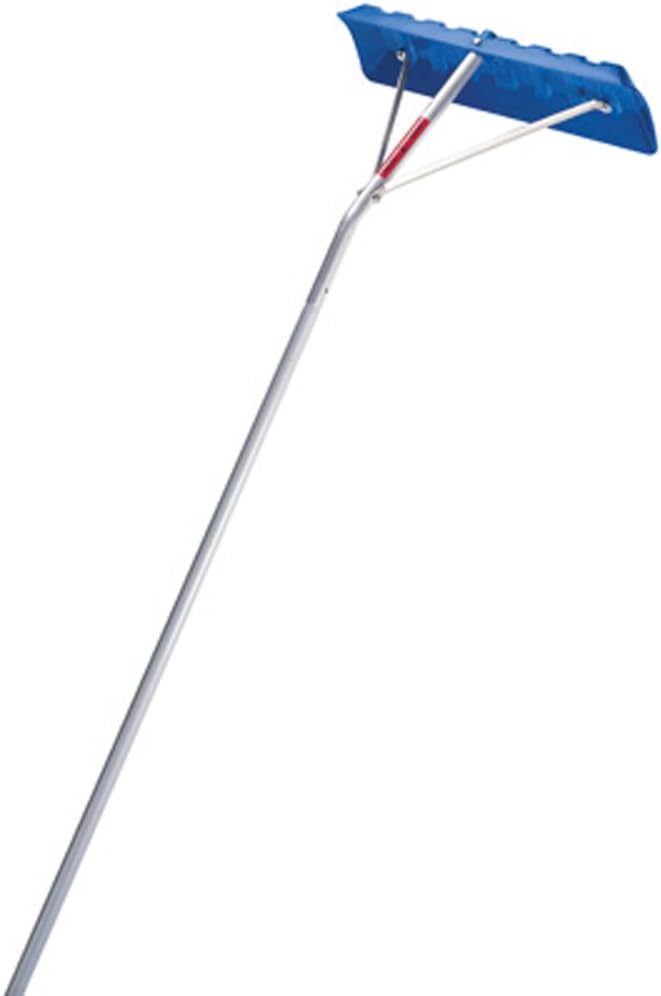
Garant GPRR24 Poly Blade Rake
Metal blades can scratch, rust, or bend. The Garant solves this by using a high-impact polyethylene blade. It is tough enough to move wet snow but gentle enough to glide over uneven surfaces without snagging. This is an excellent choice for painted metal roofs or textured synthetic slate where you absolutely want to avoid abrasion.
The poly blade also resists snow sticking to it better than cold aluminum. The handle is lightweight aluminum with anti-slip grips, though the reach is limited to 16 feet, restricting it to lower eaves.
Pros
- Poly blade won’t rust or scratch.
- Snow slides off the blade easily.
- Very lightweight and easy to handle.
- Reinforced supports prevent wobbling.
Cons
- Plastic can crack in extreme sub-zero temps.
- Short reach needs extension poles.

Docapole 6-24 Foot Extension Pole + Rake
The Docapole isn’t just a snow rake; it’s a modular pole system for year-round home maintenance. In winter, you attach the included snow rake head. In summer, you can swap it for a window squeegee, fruit picker, or duster (attachments sold separately).
The pole itself is the star here. It is significantly sturdier and thicker than most dedicated snow rakes, reducing the “wobble” and flex when fully extended to 24 or 30 feet. If you are frustrated by flimsy poles bending under the weight of wet snow, the rigid Docapole is a solid upgrade.
Pros
- Ultra-rigid pole reduces flex.
- Year-round utility (modular tip).
- Excellent locking mechanisms.
- Long reach for high peaks.
Cons
- Heavier than standard rakes.
- Rake head attachment can loosen if not checked.
Safety & Maintenance Guide
Removing snow is dangerous work. A slip on ice or a falling icicle can cause serious injury. Follow these rules to stay safe:
- Watch for Wires: Never use an aluminum rake near the power drop (where lines connect to your house). Electricity can arc to the metal pole. Use a fiberglass pole if you must work near lines.
- Leave a Layer: Don’t scrape down to the bare shingle. Leave 1-2 inches of snow to protect the granules. If you damage shingles, you may need to learn how to repair damaged shingles in the spring.
- Work in Sections: Don’t try to pull the whole roof at once. Shave off the top layer, then the bottom. Large avalanches can bury you or damage gutters and guards.
- Footwear: Even on the ground, ice is a hazard. Wear proper roofing shoes or boots with traction cleats to ensure stability while pulling.
Frequently Asked Questions
Yes, if used aggressively. Rakes without wheels or bumpers can scrape off the protective granules, exposing the asphalt to UV rays. Always choose a rake with rollers (like the Garelick) or leave a thin layer of snow on the roof.
Yes. Ice dams form when snow melts higher up the roof and refreezes at the cold eaves. By removing the snow from the bottom 3-4 feet of the roof, you eliminate the fuel source for the ice dam.
Most residential roofs can handle 20 lbs per square foot. This equates to about 4 feet of fresh fluffy snow, or just 1 foot of wet, heavy snow. If your doors start sticking or you hear creaking, clear it immediately.
Yes, but be careful not to puncture the membrane. For flat roofs, a squeegee-style head (Snow Joe) or a plastic blade is safer than metal. Check our guide on flat roof coatings to ensure your roof is sealed against standing water.