
5 Best Ladder Stabilizers for Roof 2026
A ladder resting on gutters is a disaster waiting to happen. We tested the best stand-off stabilizers to protect your home and keep you alive.
Most ladder accidents happen due to lateral instability—the ladder sliding sideways because it has poor contact with the wall. When accessing a roof, the problem is compounded by fragile gutters. Leaning a heavy extension ladder against aluminum gutters can crush them instantly, costing hundreds in repairs. Even worse, the metal-on-metal contact is inherently slippery and dangerous, especially in damp conditions.
The solution is a Ladder Stabilizer (also known as a Stand-Off). These essential accessories attach to the top of your ladder, widening the stance and physically pushing the ladder away from the wall. This allows you to rest the ladder securely on the roof shingles or the siding *below* the gutter, preventing damage and increasing stability by roughly 300%. In this comprehensive guide, we review the top 5 stabilizers for 2026, focusing on compatibility, standoff distance, and ease of installation. Before you climb, make sure you are paired with one of the best roof ladders for maximum safety.

Ladder-Max “Original” Stand-Off Stabilizer
The Gutter Savior. The Ladder-Max “Original” is widely considered the gold standard for homeowners and roofing professionals alike because it solves the biggest problem with stabilizers: installation time. Unlike cheaper models that bolt onto the ladder rails (which is slow and can damage fiberglass rails), the Ladder-Max slides onto the rungs and locks in place with heavy-duty steel loop pins. This “on-and-off in seconds” design is a massive time-saver if you move your ladder frequently around the house.
Deep Standoff Advantage: The defining feature is its massive 19-inch standoff distance. This deep reach allows the stabilizing arms to rest comfortably on the roof shingles above the gutter line, or on the siding below the eaves. This completely bypasses the gutter, meaning your ladder never touches the delicate aluminum, preventing dents, scratches, and crushing. It effectively converts your ladder into a safe access tool for cleaning gutters, installing gutter guards, or painting soffits without awkward reaching.
Safety & Durability: The unit is constructed from rugged, zinc-plated steel, making it heavier than aluminum competitors but significantly more durable against rust and impact. The orange tips are made of a non-marring, soft plastic that grips shingles without tearing them. With a wide 36-inch span, it provides exceptional lateral stability, making the ladder feel “planted” even in windy conditions. It fits almost all extension ladders and many articulating ladders (check rung spacing first).
Check PricePros
- Slides on/off rungs in seconds (no bolts needed).
- 19″ standoff creates huge workspace for tools.
- Rests on roof, completely bypassing gutters.
- OSHA rated and ANSI certified for safety.
Cons
- Bulky to store in a garage due to fixed shape.
- Heavier (7.5 lbs) adds top weight to ladder extension.

Werner AC78 QuickClick Stabilizer
The Contractor’s Default. If you own a Werner extension ladder (the most common brand in the US), the AC78 QuickClick is designed specifically for you. While other stabilizers require you to screw clamps tight every time you use them—which can be tedious—the AC78 features a patented spring-loaded locking latch. You simply snap it onto the rung and rail, and it locks instantly with a satisfying click. Removal is just as fast—press the release lever and it pops off.
Wide Span Stability: With a span of 44 inches, it is wider than the Ladder-Max, offering incredible side-to-side stability. This width is particularly useful when painting large sections of siding or cleaning wide roof windows, as you don’t have to move the ladder as often to reach new areas. However, the standoff distance is only 10 inches. This is fantastic for wall work and painting, but it may not be deep enough to span over very wide commercial gutters without touching them.
Practicality Features: It comes with a built-in paint can hook, a small but essential feature for painters that keeps your bucket secure. The rubber end caps are mar-resistant, ensuring you don’t leave black scuff marks on white vinyl siding. It is made of lightweight aluminum, adding minimal top-heaviness to your setup, which is crucial when fully extending a 28-foot ladder. Note: This unit is designed for extension ladders and may not fit multi-position ladders with non-standard rail shapes.
Check PricePros
- Tool-free QuickClick installation is fastest in class.
- Wide 44″ span maximizes lateral stability.
- Integrated paint can hook for convenience.
- Lightweight aluminum minimizes top-heaviness.
Cons
- Only 10″ standoff (might not clear wide gutters).
- Specific to standard extension ladder rail profiles.

Little Giant WingSpan Wall Standoff
The Multi-Position Specialist. Little Giant ladders are famous for their versatility, but their flared legs and unique rung designs make them incompatible with many generic stabilizers. The WingSpan is the official solution. It is engineered to attach securely to the rungs of Little Giant articulating ladders (like the Velocity, Revolution, or Xtreme) without interfering with the hinge mechanisms or the flared base.
Massive Stability Platform: The WingSpan boasts a fixed width of 50 inches—the widest on our list. This creates an incredibly stable platform, effectively widening the top of the ladder to match the flared bottom. This is ideal for spanning across wide windows, allowing you to clean or repair them without leaning the ladder against the glass. It gives a standoff of 12 inches, which is sufficient for most standard gutters and eaves, preventing the ladder from resting on the drip edge.
Robust Attachment: It attaches via a hand-tightened screw clamp system that is robust and doesn’t require tools. While it takes a minute longer to install than the Werner QuickClick, the connection feels rock solid with zero wobble. It is surprisingly lightweight for its size. If you have invested in a Little Giant system, do not try to hack a generic stabilizer onto it; buy the WingSpan for guaranteed safety and fit.
Check PricePros
- Widest span (50″) allows for maximum window clearance.
- Designed perfectly for Little Giant articulating ladders.
- Very rigid construction with no flex.
- Lightweight yet durable aluminum body.
Cons
- Not compatible with standard extension ladders.
- Screw knobs take a moment to tighten securely.
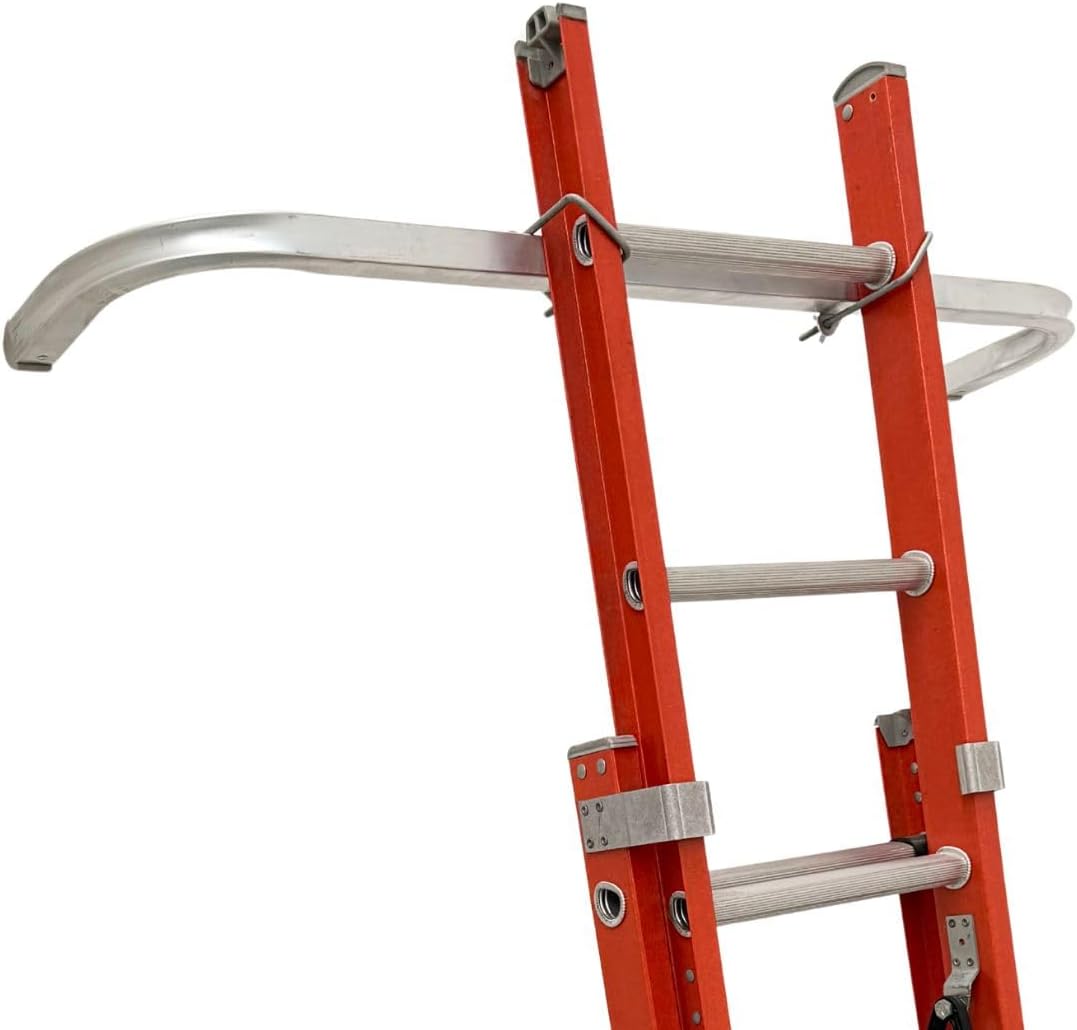
Louisville LP-2200-00 Adjustable Stabilizer
The Customizable Workhorse. While other stabilizers have fixed dimensions, the Louisville LP-2200-00 offers customization. It comes with adjustable tubes that allow you to change the standoff distance from 12 inches all the way up to 29 inches. This is a fantastic feature if you switch between working on deep roof eaves (requiring max standoff) and flush wall siding (requiring closer access).
Universal Mounting System: It uses a traditional U-bolt mounting system. While this takes a few minutes to install initially (you’ll need a wrench), it is universally compatible with almost any extension ladder with standard rails (up to 4 inches deep). It works on Werner, Louisville, and generic brands equally well. The 48-inch span is generous, providing excellent stability against walls and preventing the ladder from twisting.
Best for Permanent Install: It is often priced lower than the QuickClick or Ladder-Max, making it a great choice for budget-conscious homeowners. It includes soft rubber tips to protect your siding paint and comes with paint can hooks. However, because it is bolted on, it is best suited for users who plan to leave the stabilizer attached to their ladder permanently, rather than taking it on and off daily.
Check PricePros
- Adjustable standoff depth is unique in this class.
- Universal U-bolt fits almost any ladder brand.
- Includes paint can hooks for convenience.
- Excellent value for money.
Cons
- Installation is slow and requires tools.
- Not easily removable for storage.

Ladder-Max “Multi-Pro” for Corners
The Difficult Access Solver. Standard stabilizers are flat; they only work on flat walls or roofs. But what if you need to paint the trim on the corner of your house, or access a downspout located on an outside corner? The Multi-Pro is engineered specifically for this. Its unique inward-angled design allows it to straddle corners safely, gripping two sides of the building simultaneously for locked-in stability that feels incredibly secure.
Versatility and Strength: Manufactured by the same company as our #1 pick (Ladder-Max), the Multi-Pro is ANSI certified. It spans a massive 51 inches, allowing it to clear windows up to 4 feet wide. It is built tough and attaches securely. This tool is indispensable for painters, siding installers, and roofers dealing with complex rooflines where a flat wall isn’t available for ladder placement.
Safety Considerations: Working on corners is inherently more disorienting than flat walls due to the lack of visual reference points. The Multi-Pro provides the mechanical stability needed, but always ensure your roofing shoes have excellent grip before climbing. This unit is heavier and bulkier than the others, so it is a specialized tool for specific problem areas rather than a daily driver for simple gutter cleaning.
Check PricePros
- Safely stabilizes ladder on building corners.
- Massive 51″ span clears wide windows.
- ANSI certified durability and strength.
- Can be used on flat walls effectively too.
Cons
- Expensive specialized tool.
- Heavy and bulky to transport than standard units.
Choosing the correct stabilizer isn’t just about price; it’s about fit and function. Here are the critical factors to consider before adding one to your cart:
1. Ladder Compatibility
Not all stabilizers fit all ladders. Most are designed for Type I, IA, or IAA extension ladders with standard D-shaped or round rungs. If you own a Multi-Position ladder (like a Little Giant), generic stabilizers often won’t fit because the rung spacing or rail width is different. Always check the manufacturer’s compatibility chart. Using an incompatible stabilizer can damage your ladder’s rails and void its warranty.
2. Standoff Distance (Depth)
This is the distance the stabilizer pushes your ladder away from the wall.
10-12 Inches: Good for painting siding and general wall work.
19+ Inches: Essential for roofing. You need this depth to span over the gutters so the stabilizer rests on the roof surface, not the gutter lip. If you primarily want to protect your gutters, go for a deeper standoff like the Ladder-Max.
3. Installation Method
Quick-Connect (Spring/Pin): Best for homeowners who use their ladder for various tasks and need to take the stabilizer on and off frequently. (e.g., Ladder-Max, Werner AC78).
U-Bolt / Clamp: Best for contractors who leave the stabilizer permanently attached to a dedicated roofing ladder. It takes 5-10 minutes to install with tools but is very secure.
A stabilizer increases safety, but only if used correctly. Follow these protocols:
- Install on the Ground: Never try to attach a stabilizer while the ladder is vertical. Lay the ladder flat on the ground, attach the stabilizer securely, and then raise the ladder.
- The 3-Rung Rule: Ensure the ladder extends at least 3 feet (3 rungs) past the roofline when accessing the roof. The stabilizer helps achieve this clearance safely.
- Watch the Top Weight: Adding a 5-10 lb stabilizer to the top of a fully extended 28ft ladder makes it extremely top-heavy. Raise the ladder carefully, preferably with a spotter to foot the base.
- Check for Power Lines: Stabilizers widen your profile. Be extra vigilant about overhead power lines when raising and lowering the ladder.
It is highly recommended NOT to rest a ladder on a gutter. The concentrated weight of the ladder plus your body can crush aluminum gutters instantly. It also creates an unstable metal-on-metal contact point that can slip. Always use a stabilizer to rest on the roof or siding instead.
No. Most stabilizers are designed to fit standard extension ladders with rails up to 4 inches deep. Multi-position ladders (like Little Giant) often require proprietary stabilizers due to their unique flared legs and hinge mechanisms.
Most high-quality stabilizers come with rubberized or plastic tips designed to grip shingles without tearing them. However on very hot days when asphalt shingles are soft, it is wise to place a rubber mat under the stabilizer feet for extra protection.
Technically, no, but it does add weight to the assembly. You must account for the weight of the stabilizer (approx. 5-10 lbs) when calculating your total load. Ensure your ladder’s duty rating (Type I, IA, IAA) can support you, your tools, and the stabilizer.
Final Verdict
Investing in a ladder stabilizer is cheaper than paying your insurance deductible after a fall or replacing crushed gutters. For the absolute best protection and ease of use, the Ladder-Max Original is our top pick due to its deep standoff and tool-free installation. For Werner ladder owners wanting speed, the AC78 QuickClick is unbeatable. And for Little Giant users, the WingSpan is the only safe choice. Choose the one that fits your specific ladder, and climb with confidence.