
7 Best Ladders for Roofing 2026
Stability isn’t a luxury; it’s a requirement. We tested the best fiberglass extension and multi-position ladders to keep you safe while you work.
Roofing is consistently ranked as one of the most dangerous jobs in construction. Whether you are a professional contractor or a DIY enthusiast attempting to remove moss or inspect shingles after a storm, the ladder is your lifeline. A cheap, wobbly ladder isn’t just annoying—it is a critical liability that can lead to catastrophic falls.
For 2026, the standard for roofing ladders has shifted decisively towards non-conductive fiberglass materials and multi-positional versatility. Unlike old aluminum ladders that can flex dangerously under load, modern fiberglass options offer superior rigidity and electrical safety. In this comprehensive guide, we evaluate ladders based on duty rating (weight capacity), lateral stability features, and ease of transport. Before you climb, ensure you have the proper gear, including high-traction roofing shoes and a safety harness.

Werner D6228-2 Type IA Fiberglass Extension Ladder
The Industry Standard for a Reason. If you drive past any professional roofing site in America, you will likely see a Werner D6200 series ladder leaning against the eaves. It earns our top spot because it perfectly balances professional-grade durability with essential safety features. The core of its appeal lies in its non-conductive fiberglass rails. When working on a roof, you are often near the service drop (where power lines connect to the house). An aluminum ladder in this zone is a lethal hazard; the Werner fiberglass construction eliminates that conductivity risk entirely, making it the safest choice for roof inspections near wires.
Stability and Comfort: The D6228-2 features proprietary “TRACTION-TRED” D-rungs. Unlike the round, painful rungs of older ladders, D-rungs provide a flat, slip-resistant surface for your feet. This significantly reduces foot fatigue when standing for long periods to clean gutters or nail shingles. The base uses dual-action feet that can flip for use on soft ground (spikes dig into the grass) or hard surfaces (rubber pads grip the driveway). This versatility is crucial for homeowners looking to save on roof inspection costs by doing it themselves.
Why Type IA Matters: The 300lb load capacity is not just a suggestion; it’s a safety buffer. Remember, the load isn’t just your body weight; it’s you plus your heavy roofing tool belt, winter clothing, and potentially a bundle of architectural shingles (which can weigh 70-80 lbs alone). A Type IA ladder handles this dynamic load without the terrifying “bounce” or flex found in cheaper Type II models. Werner’s ALFLO rung joint connection also ensures the rungs don’t twist over time, maintaining structural integrity for years.
Check PricePros
- Non-conductive fiberglass rails ensure electrical safety.
- D-Rungs are comfortable for standing and offer superior traction.
- Shur-Lok system ensures safe, smooth extension without jamming.
- Extremely rigid with minimal bounce under heavy load.
Cons
- Heavy (nearly 60 lbs) makes it difficult to move solo.
- Pulley rope can degrade over time in UV light.

Little Giant Velocity Multi-Use Ladder
The Versatility King. Not every roof is accessible from a flat driveway. If you have to set up your ladder on a staircase, a steep garden slope, or uneven terrain, a standard extension ladder is dangerous or impossible to use. This is where the Little Giant Velocity shines. Its articulating legs allow you to adjust each side independently, creating a stable, level base even when the ground beneath you varies by several feet.
33 Ladders in One: It converts from an A-frame step ladder to a 22-foot extension ladder, and even splits apart to form two scaffolding trestles. This flexibility makes it incredibly useful for diverse tasks like cleaning granules in gutters or installing roof exhaust fans where you might need different angles of approach. The patented “Rock Lock” system allows you to adjust the height quickly by simply pushing a button, eliminating the pinched fingers common with older designs.
Stability Factor: While it is made of aluminum (and thus conductive—always watch out for overhead wires!), the trade-off is a lighter weight relative to its immense capability. The wide-flared legs provide a high degree of lateral stability that straight ladders simply cannot match. This wide stance gives confidence to those uneasy with heights, preventing that “tipping” sensation when you reach out to the side.
Check PricePros
- Works on stairs and uneven ground safely.
- Flared base prevents lateral tipping.
- Compact storage size fits in SUVs.
- Tip & Glide wheels aid in transport.
Cons
- Aluminum conducts electricity (risk near wires).
- Rungs are narrow compared to D-rungs.
- Heavy to extend fully when working solo.

Louisville Ladder FE3228 Fiberglass Extension
The Contractor’s Secret Weapon. The Louisville FE3228 competes directly with the Werner D6200 series, but it offers a unique innovation that many roofers prefer: the **ProTop**. The top cap of the ladder is molded with a non-marring V-shape and specific slots designed to hold tools. It can lean securely against building corners, poles, or trees without slipping, and it has dedicated slots to hold your roofing hammer, screws, drills, or paint cans.
Why It Matters: This simple feature saves you from the dangerous and exhausting task of constantly climbing up and down to retrieve tools. It acts as a third hand at the top of the ladder. Additionally, the FE3228 features “MaxLock” rung locks, which are made from a patented custom polymer. While some skeptics prefer aluminum locks, this polymer is engineered to be stronger, lighter, and impact-resistant, ensuring the lock doesn’t bend or jam over time.
Safety Features: This ladder is slightly lighter than the Werner equivalent, making it easier to maneuver around the house perimeter. It comes equipped with heavy-duty steel swivel safety shoes with thick rubber treads, biting into the ground for a secure footing. It is fully compatible with most roof ladder accessories like stabilizers (stand-offs), which we highly recommend to prevent damaging your gutters or shingles while you work.
Check PricePros
- ProTop holds tools securely, reducing trips down.
- V-Shape top allows safe leaning on corners/poles.
- Steel swivel safety shoes provide excellent ground grip.
- Smoother extension mechanism than some competitors.
Cons
- Rung locks can be stiff when new.
- Still heavy for one person to fully extend.

Little Giant King Kombo 3-in-1
The Gutter Specialist. The King Kombo is a revolutionary “lean-to” ladder that solves the biggest headache for roofers: damaging the gutters. It features a rotating wall pad at the top that allows you to lean the ladder against three distinct surfaces: flat walls, outside corners, and inside corners/studs. This versatility is a game-changer for installing gutter guards or repairing fascia boards without crushing the aluminum guttering.
Gutter Protection: Because the top pad is wide and soft, it can lean directly against the roofline or the siding *below* the gutter, bypassing the fragile metal entirely. This is a massive improvement over standard extension ladders that rely on two narrow contact points. Furthermore, it is built to Type IAA standards, meaning it supports a massive 375 lbs. If you are a larger individual or carrying heavy loads like a roofing nail gun and compressor hose, this is the sturdiest ladder on our list.
Safety Visibility: It is constructed of Hi-Viz green fiberglass. This isn’t just a branding choice; it ensures high visibility on busy job sites, preventing vehicles or other workers from accidentally striking the ladder. While it doesn’t have the height for a 2-story roof access, it is the ultimate perimeter tool for single-story work and gutter maintenance.
Check PricePros
- Rotating pad protects delicate gutters.
- Fits inside/outside corners for fascia work.
- Massive 375lb weight capacity (Type IAA).
- Hi-Viz Green enhances job site safety.
Cons
- Limited reach (not suitable for high roofs).
- Expensive for its size compared to standard ladders.

Gorilla GLMPXA-18 Multi-Position Ladder
The Heavy Duty Beast. If the Little Giant Velocity is a pickup truck, the Gorilla MPXA is a tank. It is rated for an impressive 375 lbs (Type IAA), making it significantly stronger than most standard ladders. The hinge locks are oversized and engineered to be operated easily, even when wearing thick work gloves in winter conditions.
Unshakable Stability: The main selling point here is the rock-solid feel. The base is exceptionally wide, and the feet are armored with heavy-duty tread that bites into concrete or soil. When fully extended to access a roof, it feels significantly less “whippy” than lighter aluminum ladders. This rigidity is vital when you are transitioning from the ladder to the roof surface—a critical moment where most slips and falls occur. The Gorilla gives you a stable platform to make that step with confidence.
Configuration Options: Like other multi-position ladders, it can be configured as an extension ladder, a double-sided twin stepladder (allowing two people to work), or a 90-degree wall ladder. The 90-degree setting is particularly useful for getting close to the siding to install flashing without tipping over. Just be warned: this stability comes at the cost of weight. It is heavy, so be prepared for a workout moving it around.
Check PricePros
- Extreme 375lb weight capacity handles heavy loads.
- Oversized hinges are glove-friendly.
- Very rigid when extended; minimal bounce.
- Armored feet provide superior grip.
Cons
- Very heavy to move around the yard.
- Conductive Aluminum (avoid power lines).

Xtend & Climb 785P Aluminum Telescoping Ladder
The Inspector’s Choice. Not everyone has a truck with a ladder rack. The Xtend & Climb 785P collapses down to just 36 inches, fitting easily into the trunk of a sedan, a hall closet, or the backseat of a car. This makes it the ideal choice for insurance adjusters, real estate agents, or homeowners who only need occasional roof access for visual inspections.
True Telescoping Tech: Unlike cheap knock-offs that can pinch fingers or collapse unexpectedly, Xtend & Climb uses patented “True Telescoping Technology.” It extends by the foot, locking securely at each rung level with visual indicators (green means locked, red means unlocked). This allows you to set it to the exact height needed, whether you are checking a low porch roof or a high gutter. It is constructed from aerospace-grade aluminum alloy with a clean anodized finish that keeps your hands clean.
Limitations: While convenient, we do not recommend this for heavy construction work or carrying bundles of shingles. It has a 250lb weight limit (Type I) and inherently has more flex than a rigid extension ladder. It is perfect for checking roof flashing or clearing a few leaves, but for sustained work, stick to a rigid ladder.
Check PricePros
- Ultimate portability (fits in a car trunk).
- Adjustable height by the foot for precise setup.
- Aerospace-grade aluminum is durable and clean.
- Ideal for quick inspections and estimates.
Cons
- Lower weight capacity (250 lbs).
- Finger pinch hazard if collapsed incorrectly.
- More flex/bounce than rigid ladders.
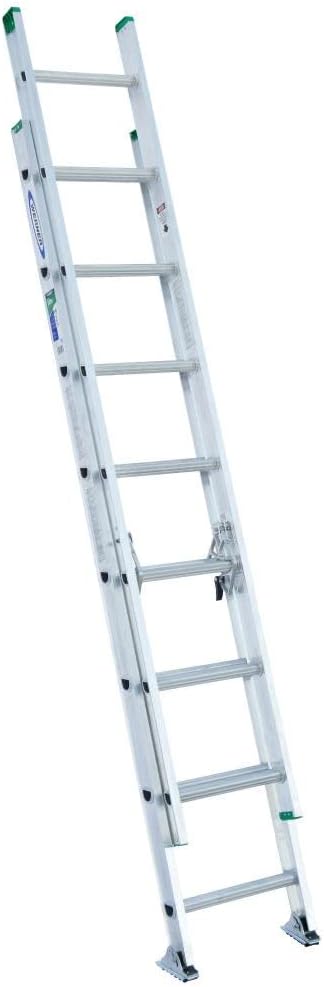
Werner D1216-2 Aluminum Flat D-Rung Extension Ladder
The “Grab-and-Go” Solution. For single-story homes, low eaves, or interior access hatches, a massive 28-foot extension ladder is often overkill. The Werner D1216-2 fills the niche for a highly portable, manageable ladder that one person can carry under one arm. At 16 feet (with a max working reach of roughly 13 feet), it is perfectly sized for accessing the roof of a garage, shed, or a low ranch-style home without the hassle of setting up heavy equipment.
Structural Integrity: Despite being a lightweight aluminum model, Werner has engineered out the “wobble” typically associated with metal ladders. It features their exclusive Alflo rung joint connection. This twist-proof technology ensures that the rungs remain rigid and square to the rails, preventing that unnerving feeling of the ladder twisting beneath you as you climb. The side rails are modified I-beams, which provide maximum strength-to-weight ratio. Additionally, the Traction-Tred D-rungs offer a deeply serrated, flat surface that grips your boot soles, reducing slips even in damp morning conditions.
Operational Simplicity: Unlike larger ladders, the D1216-2 does not include a rope and pulley system. At this size, gravity and simple mechanics are all you need. You simply push the fly section up by hand, and the spring-loaded heavy-duty gravity locks snap securely onto the rungs. This reduces the number of moving parts that can tangle or break. It also features pivoting shoes with dual treads: a rubber pad for hard surfaces and a spur edge for digging into grass or dirt.
Important Limitations: This is a Type II Medium Duty ladder rated for 225 lbs. It is designed for painting, cleaning gutters, and light inspection work. It is not designed to carry a 200lb roofer plus an 80lb bundle of shingles. Furthermore, because it is aluminum, it is highly conductive. Never use this ladder near service drops or power lines. If you need to access a second story, this ladder is too short; always follow the 4-to-1 safety rule which requires the ladder to extend 3 feet past the roofline.
Check PricePros
- Ultra-lightweight and easy to transport solo.
- Alflo joints prevent twisting/wobbling.
- No rope/pulley to tangle or degrade.
- Modified I-beam rails for high rigidity.
Cons
- Limited reach (13ft working height).
- Lower weight capacity (225 lbs).
- Conducts electricity (Danger near wires).
Owning the best ladder is meaningless if you don’t know how to use it safely. Here are the critical rules every homeowner must follow before stepping on the first rung.
The 4-to-1 Rule
This is the golden rule of ladder stability. For every 4 feet of height up to the point of support (the roofline), the base of the ladder should be 1 foot away from the wall. For example, if your roof is 20 feet high, the ladder base should be 5 feet away from the house. This creates the optimal 75-degree climbing angle.
3-Foot Extension Rule
When accessing a roof, the ladder must extend at least 3 feet (3 rungs) past the roofline. This provides a handhold for you to transition safely from the ladder to the roof and back. Never step on the top 3 rungs of an extension ladder.
Ground Stability
Always place the ladder on firm, level ground. If working on grass, flip the ladder shoes to engage the spur spikes. If on concrete, ensure the rubber pads are clean and dry. Use a leg leveler accessory if the ground is uneven; never use bricks or boards to level a ladder.
For a standard single-story house (approx. 9-10 ft to the eaves), a 16-foot or 20-foot extension ladder is ideal. This allows for the proper angle and for the ladder to extend 3 feet past the roof edge for safety.
For roofing, yes. Fiberglass is non-conductive (won’t electrocute you if it touches a wire), stronger, and more rigid. Aluminum is lighter and cheaper but conducts electricity and flexes more.
Duty Rating indicates the maximum weight capacity. Type III (200 lbs) is light duty. Type II (225 lbs) is medium. Type I (250 lbs) is heavy duty. Type IA (300 lbs) and IAA (375 lbs) are professional grades recommended for roofing work.
If you only need a tall 40ft ladder once for a specific repair, renting is cheaper and solves the storage problem. However, for a standard 20-28ft ladder, buying is usually better as the cost is recouped after just a few uses.
Store fiberglass ladders indoors or in the shade. Prolonged exposure to UV sunlight can degrade the resin, causing “fiber bloom” where the glass fibers become exposed and itchy to touch. Waxing the rails once a year can help protect them.
Final Verdict
For most homeowners and professionals, the Werner D6228-2 Fiberglass Extension Ladder is the undisputed champion due to its safety features and rigidity. If you need versatility for stairs or uneven ground, the Little Giant Velocity is the smartest investment. And for quick inspections or limited storage, the Xtend & Climb 785P offers unmatched convenience. Always prioritize safety over price—a stable ladder is the most important tool in your arsenal.